

 Locations
 Hours
Hours Call Us Now
 Book Appointment


You are driving along Route 29 near Gainesville Crossing when a dump truck pulls out from a construction entrance. You move over slightly, hit a rough transition in the pavement, and feel the steering wheel jerk in your hands.
It does not seem serious.
There is no warning light, no loud noise, and the vehicle still drives normally.
A few days later, however, your SUV starts feeling a little loose on I-66. It drifts slightly when changing lanes. Maybe the tires are low. Maybe it is just the wind.
Then your Virginia State Inspection is coming up, and you begin wondering whether something underneath the vehicle is starting to wear out.
That is usually when drivers begin looking for suspension repair in Gainesville.
I’m Donnie, owner of Advanced Automotive, and over the last several years we have noticed a clear pattern. The rapid construction growth around Gainesville has created a different type of wear on local vehicles.
It is not just potholes causing problems.
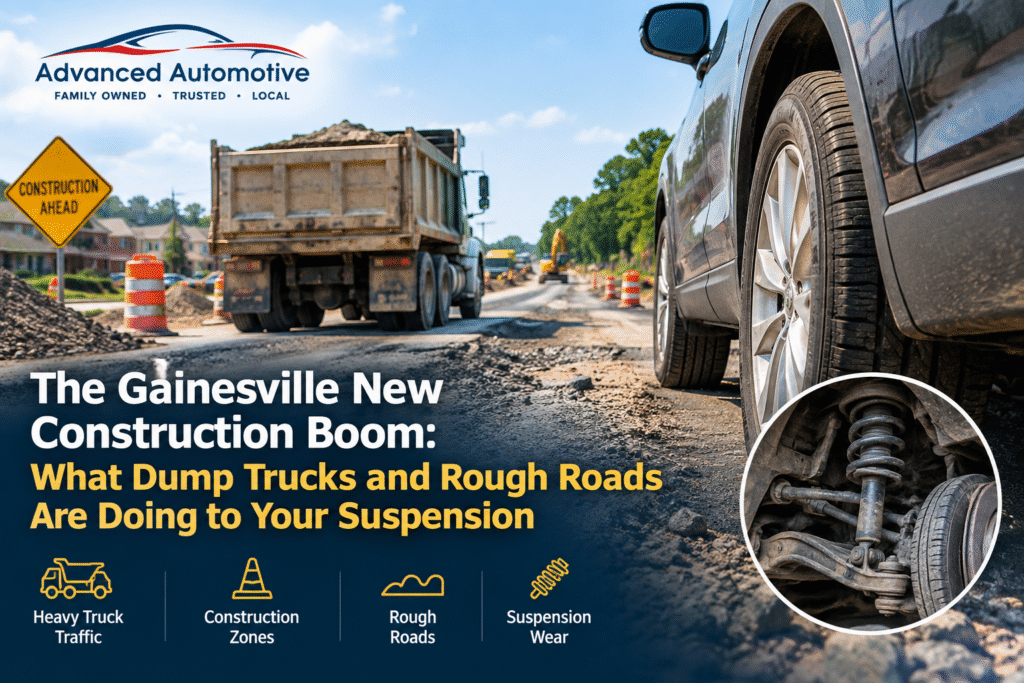
Uneven pavement, temporary road surfaces, gravel and debris from construction entrances, heavy dump-truck traffic, constant road work, and repeated braking and acceleration are all putting additional stress on suspension and steering components.
Understanding how this wear develops can help you catch problems earlier and potentially avoid much larger repair bills later.
What Is Actually Happening to Your Suspension?
Your suspension system does much more than make the ride comfortable.
It helps keep your tires in contact with the road, controls vehicle movement, supports steering, and maintains stability while braking, accelerating, and turning.
The system includes components such as shocks, struts, ball joints, tie rods, control arms, bushings, stabilizer links, wheel bearings, and suspension mounts.
Every time your vehicle hits a bump, expansion joint, pothole, temporary pavement edge, or uneven road surface, these components absorb part of the impact.
One hard impact can certainly cause damage, but the bigger problem is often thousands of smaller impacts over time.
That is what makes today’s Gainesville driving conditions different.
Constant exposure to construction areas can create repeated stress cycles. Rubber bushings gradually crack. Ball joints begin developing play. Tie rod ends can loosen. Shocks and struts slowly lose their ability to control movement.
Most drivers do not notice these changes immediately.
The vehicle may continue driving normally while wear is slowly developing underneath.
Suspension Problems Rarely Stay Isolated
One of the most important things drivers should understand is that a worn suspension component can affect other parts of the vehicle.
For example, a worn ball joint may allow unwanted wheel movement, which can change alignment angles and create uneven tire wear.
A weak shock or strut may allow excessive bouncing and place additional stress on control arm bushings and other components.
A steering component with excessive play can make the vehicle wander and also affect tire contact with the road.
Poor alignment can then accelerate tire wear even further.
That is why suspension problems often become more expensive when they are ignored.
The first issue may be relatively small. But as movement increases, surrounding parts begin working harder.
By the time the driver notices significant handling changes, more than one component may already be worn.
Why Gainesville Construction Creates Unique Vehicle Wear
Gainesville has changed considerably over the years.
New neighborhoods, commercial developments, road widening projects, and ongoing construction have increased traffic and introduced more heavy equipment onto local roads.
Areas around Route 29, Route 55, University Boulevard, and the I-66 corridor regularly see construction vehicles, temporary road surfaces, and changing traffic patterns.
Construction entrances are especially hard on suspension systems.
Dump trucks and other heavy equipment often carry gravel, dirt, and debris onto the roadway. Pavement near these entrances may become uneven, rough, or broken down.
Drivers may cross the same rough transition twice every day during their commute.
Over a month, that becomes dozens of impacts.
Over a year, it becomes hundreds.
Drivers coming from Haymarket, Bristow, and surrounding communities may experience several construction areas during a single trip.
The vehicle may appear to be handling those impacts without a problem, but the suspension is constantly absorbing the stress.
Stop-and-Go Traffic Adds Even More Stress
Suspension components do not only work when you hit potholes.
They also manage weight transfer.
When you brake, the vehicle’s weight shifts forward.
When you accelerate, the weight shifts toward the rear.
When you turn, the suspension controls side-to-side body movement.
Heavy Gainesville traffic creates repeated braking and acceleration, particularly around shopping areas, construction zones, intersections, and I-66 access points.
This constant loading and unloading places additional demand on shocks, struts, bushings, ball joints, and steering components.
The combination of rough pavement and congested traffic can create a wear pattern that is very different from steady highway driving.
That is why understanding how a vehicle is being used is an important part of suspension diagnosis.
What Tire Wear Can Tell You About Your Suspension
Your tires often reveal suspension problems before the driver notices anything unusual.
Different wear patterns can point toward different mechanical concerns.
Inner-edge or outer-edge wear may indicate alignment problems.
Feathering across the tread can sometimes be related to toe-angle issues.
Cupping or scalloped wear may indicate worn shocks, struts, or suspension components.
The important thing is not to simply replace the tires and ignore the cause.
If worn suspension parts are affecting alignment, the replacement tires may begin wearing unevenly too.
That turns what could have been a suspension inspection into another expensive set of tires.
Checking the steering and suspension when unusual tire wear appears can help prevent that cycle.
How We Inspect Suspension Problems at Advanced Automotive
When a customer comes to Advanced Automotive with suspension concerns, we do not immediately start replacing parts.
We begin with diagnosis.
A road test is often the first step.
We listen for clunks, pops, rattles, steering wander, vibration, and instability. Some suspension problems become much easier to identify when the vehicle is being driven.
Next, we perform a complete undercar inspection.
Our technicians inspect ball joints, tie rod ends, control arm bushings, stabilizer links, shocks, struts, suspension mounts, wheel bearings, and steering components.
We also check for excessive movement, looseness, damaged rubber components, leaks, and signs of physical wear.
Tire condition is evaluated as part of the process because tread wear can provide important clues.
If alignment may be involved, wheel angles can be measured and compared with manufacturer specifications.
The goal is to determine exactly what is worn and what still has useful service life.
Warning Signs Gainesville Drivers Should Watch For
Suspension wear usually develops gradually.
A vehicle that suddenly begins pulling left or right while driving straight may have an alignment, tire, steering, or suspension problem.
Clunking sounds when driving over bumps can sometimes be related to worn ball joints, sway bar links, or bushings.
Excessive bouncing may suggest worn shocks or struts.
Loose steering or vehicle wandering can indicate wear in steering components.
A vehicle that nose-dives noticeably while braking may have weakened front suspension components.
Uneven tire wear is another important warning sign.
Highway-speed vibration can also be related to tires, wheel balance, steering, wheel bearings, or suspension wear.
One symptom does not automatically mean major repairs are necessary.
But when several symptoms appear together, the vehicle should be inspected before the problem becomes worse.
What Suspension Repair May Cost
Suspension repair costs vary significantly depending on the vehicle and which components are worn.
A minor repair such as replacing a stabilizer link or bushing may cost relatively little compared with replacing multiple control arms, shocks, struts, or steering components.
For Gainesville drivers, suspension-related repairs may range from approximately $150 to more than $2,000, depending on the work required.
Vehicle make and model, parts availability, the number of worn components, labor requirements, alignment needs, and parts selection can all affect the final cost.
The best way to control repair costs is often early diagnosis.
Catching one worn component before it damages other parts or destroys a set of tires can make a significant financial difference.
At Advanced Automotive, we explain what we find and provide a clear estimate before work begins.
If a part is still safe and functioning properly, we will tell you.
The Bottom Line for Gainesville Drivers
The Gainesville construction boom has changed more than traffic patterns.
It has also changed the type of stress local vehicles experience every day.
Heavy dump trucks, construction entrances, rough pavement transitions, road debris, congestion, and constant braking can slowly wear steering and suspension components.
The important thing to remember is that suspension damage does not always begin with a major pothole or obvious failure.
Often, it begins with a small clunk, a little steering wander, uneven tire wear, or a vehicle that simply does not feel as stable as it used to.
Those early warning signs are worth paying attention to.
If your vehicle feels different after months of driving around construction zones in Gainesville, Route 29, Route 55, University Boulevard, or the I-66 corridor, having the suspension inspected early can help prevent a smaller issue from becoming a larger repair.
At Advanced Automotive, every repair is backed by our 12-month / 12,000-mile warranty on parts and labor. We also offer free towing with qualifying repairs and free pickup and delivery throughout the Gainesville and Warrenton area.
Call us at (703) 665-1818 or visit 13380 University Blvd, Gainesville, VA.
We also serve Warrenton, Haymarket, Bristow, Manassas, Centreville, and surrounding Northern Virginia communities.
Our goal is simple: find what is actually worn, explain it clearly, and help keep your vehicle stable and safe on Gainesville roads.
 Oil Change Gainesville
 Auto Brake Repair Gainesville, VA
  Towing Services Gainesville
  Fleet Services Gainesville
  Virginia Safety & Emissions Inspections
  Air Conditioning & Heating
  Wheel Alignment Warrenton
  Vehicle Diagnostic
  Auto Transmission Repair