

 Locations
 Hours
Hours Call Us Now
 Book Appointment


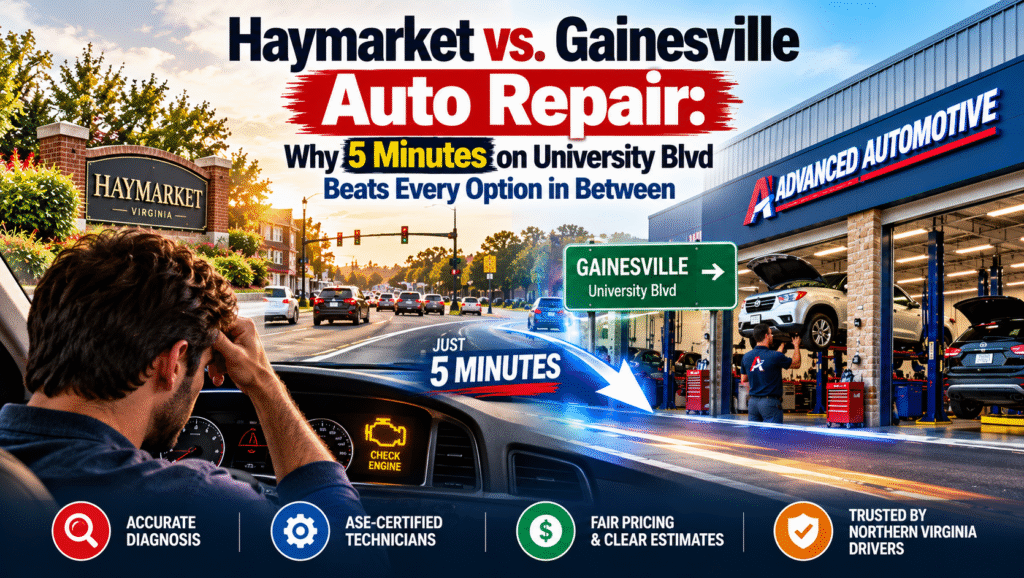
When the check engine light suddenly appears while you are driving through Haymarket, your first thought is usually simple: where can I get this checked quickly without losing an entire day?
For many drivers, the natural reaction is to search for the nearest Haymarket auto repair shop. Convenience matters, especially when you are dealing with an unexpected warning light, strange noise, vibration, brake issue, or performance problem. However, choosing the closest shop is not always the same as choosing the right shop.
The most important part of auto repair is not how close the shop is to your home. It is whether the technicians can identify the real cause of the problem, explain it clearly, and recommend the correct repair the first time.
At Advanced Automotive in Gainesville, that has been the focus for more than 35 years. Drivers from Haymarket, Gainesville, Bristow, Warrenton, Manassas, and surrounding Northern Virginia communities come to us because they want straightforward answers, accurate diagnostics, and repairs based on actual findings rather than guesswork.
For Haymarket drivers, the short trip down University Boulevard can be worthwhile when it leads to a more accurate diagnosis and a better overall repair experience.
Accurate Diagnosis Matters More Than Distance
Most auto repair shops promote similar qualities. They talk about honest service, fair pricing, experienced technicians, and dependable repairs. Those things are important, but what matters most is what happens after your vehicle enters the service bay.
Modern vehicles are complicated. A warning light or unusual noise does not always point directly to one specific failed component.
For example, a check engine light may show a code related to an oxygen sensor, but that does not automatically mean the oxygen sensor itself has failed. The real cause could be a vacuum leak, fuel delivery problem, exhaust issue, wiring concern, or another condition affecting the sensor reading.
The same is true with suspension noises. A customer may hear a clunk and assume the shocks are worn, while the real problem could involve control arm bushings, sway bar links, ball joints, or another suspension component.
Replacing parts without confirming the cause can become expensive very quickly.
That is why professional diagnostics should come before repair recommendations. A qualified technician should inspect the vehicle, test the affected systems, verify the failure, and then explain what needs attention.
The goal should always be to solve the problem rather than simply replace parts until the symptom disappears.
Local Driving Conditions Affect Your Vehicle
Haymarket and Gainesville drivers face conditions that can place significant stress on vehicles.
Daily traffic on I-66 is one of the biggest examples. Frequent stopping, accelerating, braking, and idling can increase wear on several systems. Brakes may wear faster, cooling systems work harder, and transmissions can experience additional heat compared with vehicles driven mostly on open highways.
Route 29 and the surrounding Gainesville area also continue to experience development, road work, construction traffic, and heavy commercial vehicles. Uneven pavement, changing traffic patterns, potholes, and construction zones can affect tires, suspension components, wheel alignment, and steering.
Many Northern Virginia residents also commute toward Fairfax, Tysons, Arlington, or Washington, D.C. These longer commutes often involve hours of slow-moving traffic each week.
That creates repeated engine heat cycles, more brake use, increased battery demand, and additional stress on cooling and charging systems.
Even short local trips can have an impact. When a vehicle is driven only a few miles at a time, the engine may not always reach full operating temperature. Over time, moisture can remain in the engine oil or exhaust system, especially when short trips are repeated frequently.
Understanding these local driving patterns helps technicians make better maintenance recommendations because the way a vehicle is used can be just as important as its mileage.
A Better Repair Process Starts With Listening
A good diagnosis often begins before a technician opens the hood.
When a vehicle arrives with a problem, the details provided by the driver can offer important clues.
When did the noise begin? Does it happen while braking, turning, accelerating, or idling? Is the problem worse when the vehicle is cold? Does the vibration occur at a specific speed? Did a warning light appear before or after the vehicle started behaving differently?
Those details help narrow down the inspection process.
At Advanced Automotive, our ASE-certified technicians use professional diagnostic equipment along with hands-on inspection and testing. Depending on the issue, the process may include checking computer fault codes, brake wear, suspension components, steering parts, fluid conditions, charging systems, tire wear, and alignment measurements.
The important part is verification.
A code alone should not automatically lead to a repair. A noise alone should not automatically lead to replacing a component. The technician should confirm why the problem is happening before recommending the solution.
This approach can save customers significant time and money because it reduces unnecessary repairs and helps prevent repeat visits for the same issue.
Clear Communication Should Be Part of Every Repair
Vehicle repairs can feel stressful, especially when the problem is unexpected.
Customers should not have to approve expensive repairs without understanding what is wrong.
A professional repair shop should be able to explain the issue in simple language. You should know which component has failed, why it needs attention, what could happen if the repair is delayed, and how urgent the problem is.
A clear written estimate should also be provided before repair work begins.
Customers should not be surprised by unexplained charges or additional repairs they never approved.
When possible, repairs should also be prioritized. Some problems require immediate attention because they involve safety or could cause additional vehicle damage. Other issues may be important but can safely wait.
Knowing the difference helps customers manage their maintenance budget instead of feeling pressured to repair everything at once.
Warning Signs of a Poor Repair Experience
There are several signs that a repair shop may not be taking the correct approach.
Be cautious if a major repair is recommended before any meaningful inspection or testing is completed. It is also worth asking questions if nobody can explain why a part has failed or what evidence led to the recommendation.
Repair advice should remain consistent with the vehicle’s actual condition. If recommendations change dramatically without a clear explanation, customers have every reason to ask for more information.
Vague estimates are another concern. A professional repair facility should provide specific information about the work being recommended rather than simply listing broad descriptions.
Pressure is also unnecessary.
Customers should have enough information to make their own decision. When the problem is explained properly and the repair makes sense, most customers do not need to be pushed into approving the work.
Trust is built through communication, not sales pressure.
Understanding Auto Repair Costs
One of the first questions most customers ask is how much the repair will cost.
There is no honest way to answer that question until the vehicle has been properly inspected.
Two vehicles with similar symptoms can require completely different repairs.
Brake service, for example, may involve only pads on one vehicle, while another may require pads, rotors, caliper service, or additional components.
Suspension repairs can range from one worn part to several components that have deteriorated over time.
Diagnostic problems vary as well. A warning light may be caused by a relatively minor issue or something that requires more extensive testing and repair.
That is why accurate diagnosis should always come before pricing.
At Advanced Automotive, customers receive an estimate before authorized repair work begins. This allows them to understand the expected cost and make an informed decision.
Repairs can also be prioritized when appropriate so customers know what needs immediate attention and what can be planned for later.
Why Haymarket Drivers Choose Gainesville
The difference between Haymarket and Gainesville is only a short drive, but the quality of diagnosis can make a much bigger difference than those extra minutes on the road.
Most drivers are not looking for the closest possible repair shop. They are looking for a place they can trust.
They want someone to identify the problem correctly, explain the findings, provide a clear estimate, and avoid recommending repairs that are not necessary.
That philosophy has guided Advanced Automotive for more than 35 years.
Our technicians work to provide practical recommendations based on the condition of the vehicle. Repairs are backed by a 12-month or 12,000-mile warranty on parts and labor, and additional convenience options may include free towing with repair as well as pickup and delivery in qualifying areas.
For many Haymarket customers, the decision becomes less about distance and more about confidence.
A few extra minutes on University Boulevard can be a small tradeoff when it helps you avoid unnecessary repairs, repeat visits, and unanswered questions.
If your vehicle has a warning light, unusual sound, brake concern, suspension issue, inspection need, or general maintenance problem, Advanced Automotive is located at 13380 University Blvd, Gainesville, VA.
Call (703) 665-1818 to speak with the team or visit the shop for assistance.
Advanced Automotive serves drivers throughout Gainesville, Haymarket, Bristow, Warrenton, Manassas, and surrounding Northern Virginia communities with a focus on accurate diagnostics, clear communication, and dependable automotive repair.
 Oil Change Gainesville
 Auto Brake Repair Gainesville, VA
  Towing Services Gainesville
  Fleet Services Gainesville
  Virginia Safety & Emissions Inspections
  Air Conditioning & Heating
  Wheel Alignment Warrenton
  Vehicle Diagnostic
  Auto Transmission Repair