

 Locations
 Hours
Hours Call Us Now
 Book Appointment


Electric vehicles are becoming a familiar sight across Northern Virginia. From daily commutes along I-66 to family trips between Gainesville, Haymarket, and Manassas, drivers are choosing electric transportation for its convenience, performance, and reduced maintenance requirements.
However, owning an electric vehicle does not eliminate the need for professional care. Although EVs do not require many traditional engine services, their tires, brakes, suspension, and other essential systems still experience wear.
At Advanced Automotive in Gainesville, our approach is straightforward: understand the vehicle, inspect the systems that matter, and explain the findings clearly. Knowing what your EV needs helps you protect its performance while avoiding unnecessary maintenance expenses.
Less Maintenance Does Not Mean No Maintenance
A fully electric vehicle does not have a gasoline engine, which removes the need for engine oil changes, spark plug replacements, fuel injector servicing, and exhaust system repairs. These differences simplify ownership and can reduce routine maintenance costs.
Nevertheless, many familiar automotive components remain. Steering systems, wheel bearings, suspension bushings, brake components, and cabin filters all require attention. Depending on the vehicle, thermal management systems also help regulate battery and drivetrain temperatures.
Maintenance requirements vary between manufacturers and models. A Tesla may have different service recommendations from a Rivian, Hyundai Ioniq, Kia EV6, Ford Mustang Mach-E, or Chevrolet Bolt.
The best starting point is the manufacturer’s maintenance guidance, supported by inspections that account for mileage, driving conditions, and vehicle condition.
How Northern Virginia Driving Affects Your EV
Northern Virginia presents a varied driving environment. Commuters encounter highway congestion, construction zones, uneven pavement, and changing seasonal conditions. Drivers traveling through Gainesville and nearby communities may also regularly use rural roads.
Potholes and rough surfaces can affect wheel alignment and place stress on suspension components. Winter road salt can contribute to corrosion, while seasonal temperature changes influence tire pressure and driving range.
Many electric vehicles are heavier than similarly sized gasoline vehicles because of their battery packs. Combined with strong acceleration, this can make tire selection, inflation, and alignment particularly important.
A maintenance plan should reflect how the vehicle is used. A driver covering substantial commuting mileage may need more frequent inspections than someone who primarily makes short local trips.
Tires and Alignment Deserve Regular Attention
Tires directly influence an EV’s handling, comfort, efficiency, and braking performance. Incorrect pressure or uneven wear can affect driving range and lead to premature replacement.
During an inspection, technicians should measure tread depth, check inflation against manufacturer specifications, and examine wear across each tire. Excessive wear along an edge may suggest an alignment concern or a worn suspension component.
Tire rotation should follow the vehicle manufacturer’s recommendations. Some vehicles have different front and rear tire sizes or directional tires, which can limit rotation options.
If your vehicle pulls to one side, develops steering vibration, or shows uneven tread wear, arrange an inspection. Addressing the cause early can help protect expensive tires and restore predictable handling.
Regenerative Braking Still Requires Brake Care
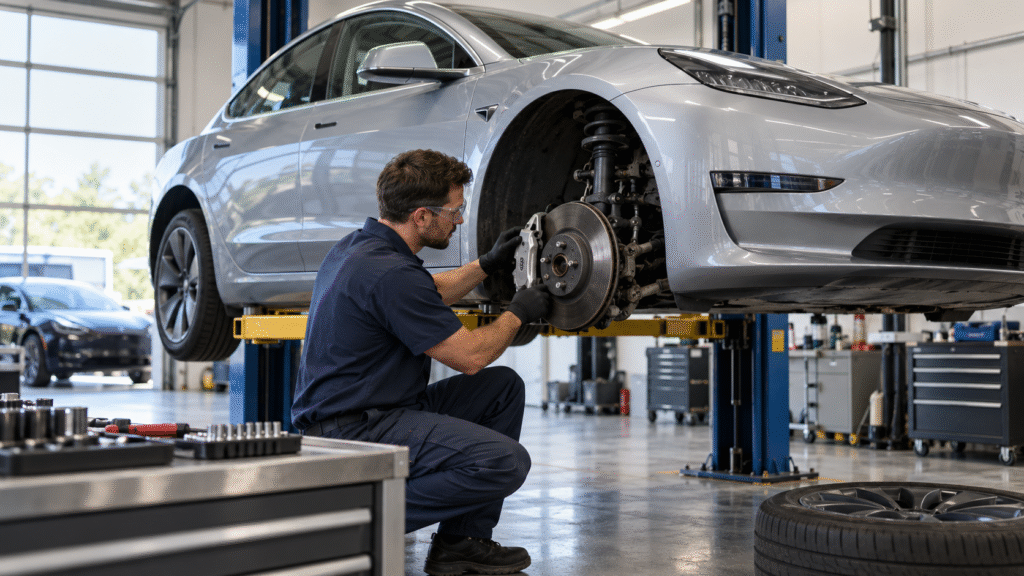
Regenerative braking captures energy during deceleration and reduces reliance on conventional friction brakes. This can help brake pads last longer, but it does not remove the need for brake inspections.
Rotors may develop corrosion, and caliper components can become restricted over time, particularly where moisture and winter road treatments are common. Brake fluid also requires attention according to the manufacturer’s guidance.
An EV brake inspection should assess pads, rotors, caliper operation, fluid condition, and parking brake function.
Persistent squealing, grinding, changes in pedal feel, or reduced braking performance deserve prompt evaluation. A technician can determine whether the issue involves surface corrosion, wear, or another condition requiring repair.
Suspension and Steering Support Everyday Safety
An EV’s quiet cabin can make suspension noises easier to notice. Clunks over bumps, rattles during turns, or changes in steering feel may indicate components that need inspection.
Control arm bushings, ball joints, shocks, struts, steering linkage, and wheel bearings help maintain stability and ride quality. Wear in these systems can also contribute to poor alignment and uneven tire wear.
A thorough inspection should identify the source of the concern before recommending replacement parts. Noise alone does not establish which component has failed.
If your vehicle feels unstable, develops unusual vibration, or displays a suspension warning, professional diagnosis helps determine the appropriate next step.
Cooling Systems and Cabin Filters Matter
Many EVs use liquid cooling to manage temperatures within the battery and other drivetrain components. These systems require the correct fluids and service procedures.
Coolant requirements and replacement intervals vary considerably. Service should follow model-specific guidance rather than a generic schedule. Visible leakage, temperature warnings, or related fault messages should be investigated.
Cabin air filters also deserve attention. Dust, pollen, and debris gradually accumulate, potentially reducing airflow and contributing to unpleasant odors.
Replacing a filter when recommended helps maintain cabin comfort. Heating or cooling problems, however, may require diagnosis beyond a filter replacement.
Understand Warning Messages and Range Changes
EV alerts can relate to tires, sensors, charging, electrical systems, or software. Record the exact message and note when it appears. This information helps a technician narrow down the problem.
Reduced range does not automatically indicate battery failure. Temperature, highway speed, heating or cooling use, tire pressure, and driving habits can influence energy consumption.
A sudden or persistent change should be evaluated in context. Independent shops can handle many routine services, while manufacturer warranty work, certain software functions, and specialized electrical repairs may require an authorized service facility.
Choose a Shop That Explains Its Recommendations
A qualified repair shop should explain its EV service capabilities, provide clear estimates, and distinguish urgent repairs from maintenance that can be scheduled later.
At Advanced Automotive, we focus on practical recommendations based on inspection findings. Our supplied service information includes a 12-month/12,000-mile warranty on repair parts and labor, free towing with qualifying repairs, and free local pickup and delivery. Ask our team about eligibility and applicable terms.
For Tesla and EV maintenance in Gainesville, contact Advanced Automotive at (703) 665-1818 or visit 13380 University Blvd, Gainesville, VA 20155. We serve drivers throughout Haymarket, Bristow, Manassas, Warrenton, and surrounding Northern Virginia communities.
Regular inspections and appropriate maintenance help keep your electric vehicle dependable, comfortable, and ready for the road ahead.
 Oil Change Gainesville
 Auto Brake Repair Gainesville, VA
  Towing Services Gainesville
  Fleet Services Gainesville
  Virginia Safety & Emissions Inspections
  Air Conditioning & Heating
  Wheel Alignment Warrenton
  Vehicle Diagnostic
  Auto Transmission Repair