

 Locations
 Hours
Hours Call Us Now
 Book Appointment


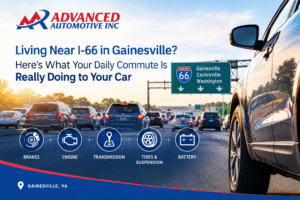
If you live in Gainesville and commute regularly on I-66, you probably know the routine all too well. You leave home, merge onto the highway, reach Route 29, and suddenly traffic begins to slow down. You move forward a few hundred feet, hit the brakes, accelerate again, and repeat the process for miles. By the time you reach Centreville or your final destination, the commute may feel like another ordinary part of your day.
But for your vehicle, that daily drive is anything but ordinary.
Stop-and-go traffic can put considerably more stress on a vehicle than steady highway driving. Frequent braking, repeated acceleration, extended idling, constant transmission shifting, and increased engine heat can all contribute to faster wear on important components. The odometer may show relatively low mileage, but the vehicle may have experienced much more mechanical stress than that number suggests.
I see this regularly at Advanced Automotive on University Boulevard. A customer may come in wondering why the brakes are wearing out sooner than expected, why the battery suddenly struggles to start the vehicle, or why the transmission doesn’t feel the way it used to. In many cases, the underlying issue isn’t simply the age or mileage of the vehicle. It’s the way the vehicle is being driven every day.
I’m Donnie, owner of Advanced Automotive. After more than 35 years of repairing vehicles throughout Gainesville, Haymarket, Bristow, Warrenton, and the surrounding Northern Virginia communities, I’ve seen firsthand how local traffic conditions can affect vehicles differently from normal highway driving.

Your Mileage Doesn’t Tell the Whole Story
Most drivers think about vehicle maintenance in terms of mileage. That’s understandable because manufacturers use mileage as an important factor when establishing maintenance schedules. However, mileage alone doesn’t tell you how hard a vehicle has actually worked.
Imagine two vehicles that each travel 10,000 miles in a year. One spends most of those miles cruising on an open highway at a steady speed. The other travels between Gainesville and Fairfax every day through heavy traffic.
Both vehicles have the same mileage, but they haven’t experienced the same driving conditions.
The second vehicle may have gone through significantly more braking cycles, acceleration and deceleration, transmission shifts, engine heat cycles, and periods of idling. It may also have experienced more stress on its cooling system, battery, tires, brakes, and suspension.
That’s why a vehicle with relatively low mileage can sometimes need maintenance sooner than its owner expects.
The odometer tells you how far the vehicle has traveled. It doesn’t tell you how difficult those miles were.
Why Gainesville Traffic Can Be Especially Hard on Your Vehicle
Gainesville has experienced substantial growth, and with more homes, businesses, and commuters comes more traffic. Roads such as I-66, Route 29, Route 15, and Linton Hall Road can become heavily congested during peak commuting hours.
Many drivers start their morning by leaving their neighborhood, merging onto a busy road, and spending a significant amount of time accelerating and braking in traffic. Instead of maintaining a consistent highway speed, the vehicle repeatedly changes speed and operating conditions.
That constant change creates additional heat and friction.
Heat is one of the biggest enemies of automotive components. Brakes generate heat every time they slow the vehicle. Transmission components and fluid are affected by repeated shifting. The engine spends more time idling and operating under changing conditions. Tires and suspension components experience additional stress from braking, turning, uneven pavement, and construction areas.
The effects are usually gradual. You may not notice a problem after one commute or even one month of commuting. But after thousands of similar trips, the accumulated wear can become noticeable.
Seasonal changes can also expose problems that have been developing for months. For example, a battery that has been subjected to months of summer heat, heavy accessory use, and frequent commuting may appear fine until cooler weather arrives. Then, suddenly, the vehicle may struggle to start.
The battery may not seem particularly old. It may simply have been working harder than expected.
How I-66 Commuting Affects Your Brakes
Your braking system is one of the first areas to feel the effects of heavy traffic.
Every time you press the brake pedal, friction between the brake pads and rotors converts the vehicle’s motion into heat. During a normal highway drive, you may travel for several miles without using the brakes heavily. During a congested commute, you may brake repeatedly within a short distance.
Over time, this can accelerate wear on brake pads and rotors and place additional stress on other components of the braking system.
If you notice squealing, grinding, vibration, a soft brake pedal, or a change in how your vehicle stops, don’t ignore it. A brake inspection can identify problems before they become more serious.
What Stop-and-Go Driving Does to Engine Oil
Your engine also experiences different conditions during a congested commute.
When driving on an open highway, the engine can often operate at relatively steady speeds and temperatures. Stop-and-go traffic is much less consistent. The engine repeatedly changes operating conditions and may spend extended periods idling.
Over time, these conditions can contribute to increased contamination and degradation of engine oil.
That doesn’t necessarily mean you need to change your oil dramatically more often than the manufacturer recommends. However, it does mean you should understand your vehicle’s maintenance schedule and determine whether your driving habits fall under the manufacturer’s definition of severe service.
For Gainesville commuters who spend significant time in heavy traffic, following the appropriate maintenance schedule can be an important part of protecting the engine.
Your Transmission Is Working Hard Too
Many drivers don’t think about their transmission until something goes wrong.
During stop-and-go traffic, the transmission is constantly responding to changes in speed and driving conditions. You accelerate, slow down, stop, and accelerate again. This creates more shifting activity than steady highway driving.
Repeated operation in traffic can increase transmission workload and fluid temperatures.
If you notice delayed engagement, hesitation, harsh shifting, unusual noises, or a change in the way your vehicle changes gears, it’s worth having the vehicle inspected.
A transmission problem that is identified early may be easier to address than one that has been allowed to develop into a major failure.
Don’t Forget About Tires and Suspension
Your tires and suspension also take a beating from daily commuting.
Repeated braking, acceleration, lane changes, potholes, uneven pavement, and construction zones can all contribute to tire and suspension wear. If the wheels are out of alignment, the problem can become even more noticeable.
You may see uneven tread wear on your tires or notice that your vehicle pulls slightly to one side. Your steering wheel may also feel off-center when you’re driving straight.
These signs shouldn’t be ignored.
An alignment or suspension inspection can help determine whether a worn component or alignment problem is affecting the way your vehicle handles and how quickly your tires wear.
Your Battery May Be Working Harder Than You Think
Modern vehicles depend on their electrical systems for much more than simply starting the engine.
Air conditioning, navigation, infotainment systems, lighting, heated seats, safety features, and other electronics all require electrical power. During long periods of commuting and idling, these systems can place additional demands on the vehicle’s charging system.
A weak battery may not give you much warning before it fails.
If you notice slower engine cranking, dimming lights, electrical problems, or difficulty starting the vehicle, have the battery and charging system tested. A simple test can sometimes identify a developing problem before you’re left with a vehicle that won’t start.
What We Look For at Advanced Automotive
When a commuter vehicle comes into Advanced Automotive, we don’t look at the mileage alone. We also consider how the vehicle is being used.
A typical inspection may include checking brake pad thickness, evaluating rotor condition, testing the battery and charging system, inspecting fluid condition, examining tire wear patterns, checking suspension components, and assessing wheel alignment.
This gives us a better understanding of the vehicle’s overall condition and helps identify problems before they become unexpected breakdowns.
For commuters, this approach is especially important because a vehicle can look perfectly fine from the outside while developing wear in components that aren’t immediately visible.
At Advanced Automotive, our repairs are backed by a 12-month/12,000-mile warranty on parts and labor. We also provide free towing with repair and complimentary pickup and delivery throughout the Gainesville and Warrenton areas.
Warning Signs You Shouldn’t Ignore
Your vehicle will often give you warning signs before a major repair becomes necessary.
If you commute regularly through Gainesville and I-66, pay attention to changes in braking performance, steering, tire wear, engine temperature, transmission behavior, starting performance, and unusual noises or smells.
A new vibration, squealing brake, slow start, fluid leak, warning light, or unusual shifting pattern may seem minor at first. However, identifying the cause early can help prevent a small issue from becoming a much larger repair.
How Gainesville Drivers Can Protect Their Vehicles
You can’t control the traffic on I-66, and you can’t eliminate every stoplight or construction zone along your commute. What you can control is how well you maintain your vehicle.
Follow the maintenance recommendations provided by your vehicle manufacturer and pay attention to whether your driving conditions qualify as severe service. Check your tire pressure regularly, monitor tire wear, keep up with oil and fluid maintenance, and don’t ignore changes in the way your vehicle sounds, feels, or handles.
It’s also a good idea to have your vehicle inspected before taking a long road trip, particularly if you already spend several hours each week in heavy traffic.
Preventive maintenance is almost always easier to deal with than an unexpected breakdown.
The Bottom Line for Gainesville Commuters
For many Gainesville residents, commuting on I-66 and surrounding roads is simply part of everyday life. But those daily miles can be harder on your vehicle than the mileage number on the dashboard suggests.
Frequent braking can accelerate brake wear. Stop-and-go driving can place additional demands on the engine and transmission. Uneven roads and constant lane changes can affect tires and suspension components. Extended idling and electrical demands can contribute to battery and charging-system stress.
None of this means you should be worried every time you get behind the wheel. It simply means that how you drive matters just as much as how far you drive.
After more than 35 years of servicing vehicles in Gainesville, Haymarket, Bristow, Warrenton, and surrounding Northern Virginia communities, we’ve learned that understanding a vehicle’s driving environment is an important part of maintaining it properly.
If your daily commute takes you through I-66, Route 29, Route 15, or the surrounding Gainesville roads, pay attention to what your vehicle is telling you.
And if something doesn’t feel right, don’t wait for a small problem to become a major repair.
At Advanced Automotive, we’re here to help keep your vehicle reliable for the commute ahead.
 Oil Change Gainesville
 Auto Brake Repair Gainesville, VA
  Towing Services Gainesville
  Fleet Services Gainesville
  Virginia Safety & Emissions Inspections
  Air Conditioning & Heating
  Wheel Alignment Warrenton
  Vehicle Diagnostic
  Auto Transmission Repair