

 Locations
 Hours
Hours Call Us Now
 Book Appointment


If you drive through Gainesville during rush hour, you already know how demanding the commute can be.
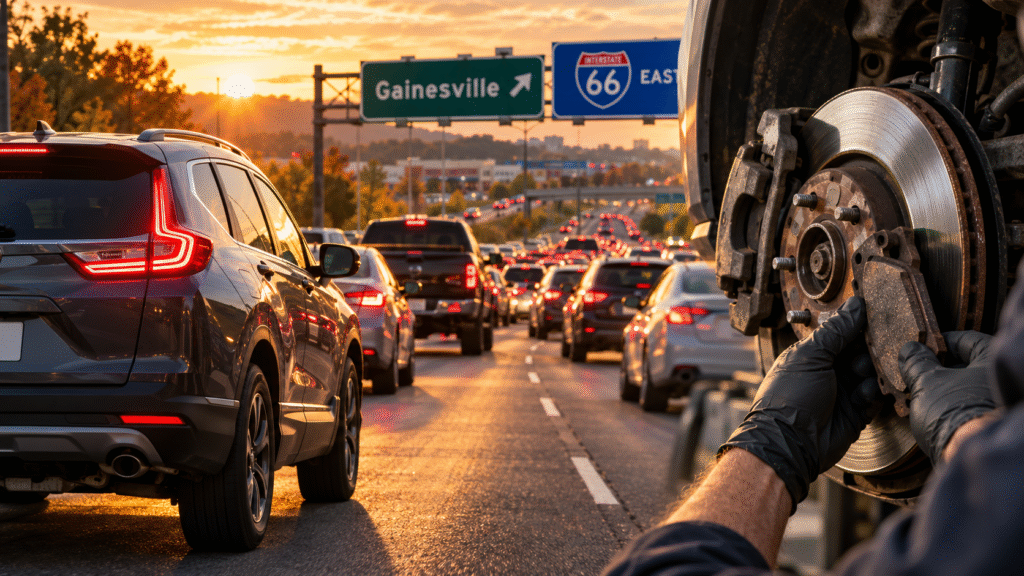
Traffic slows suddenly on I-66. Route 29 backs up. Cars inch forward near busy intersections, school zones, and shopping areas. You brake, accelerate, slow down again, and repeat the cycle for miles.
Over time, that kind of driving takes a serious toll on your braking system.
At Advanced Automotive, we’ve served Northern Virginia drivers for more than 35 years, and one thing we’ve consistently seen is that vehicles driven around Gainesville often experience faster brake wear than vehicles driven primarily in less congested areas.
That doesn’t necessarily mean there is something wrong with your brake pads or that you purchased low-quality parts. In many cases, the real issue is simply how and where the vehicle is driven.
Here’s why Gainesville traffic can shorten brake life, what warning signs drivers should watch for, and how regular inspections can help prevent costly brake repairs.
Why Stop-and-Go Traffic Wears Brakes Faster
Brake pads are designed to wear gradually.
Whenever you press the brake pedal, the brake pads press against the rotors, creating friction that slows the vehicle. That friction creates heat, and repeated heat cycles gradually wear down the braking components.
The more frequently you brake, the faster the system wears.
This is why highway mileage alone doesn’t tell the full story.
A driver who travels 50 miles each day on open highways may use the brakes only a handful of times during the commute. Meanwhile, someone traveling 20 miles through Gainesville traffic may apply the brakes dozens or even hundreds of times.
That difference can significantly affect brake life.
Stop-and-go driving is especially demanding because the brakes often do not have much time to cool between applications. Repeated heating and cooling can contribute to faster pad wear and may also affect rotor condition, brake fluid, calipers, and other components.
In short, two vehicles can have the exact same mileage but very different brake conditions depending on how those miles were driven.
Why Gainesville Is Tough on Brake Systems
Gainesville has experienced substantial residential and commercial growth over the years. With more neighborhoods, businesses, schools, and commuters, local traffic has become increasingly demanding.
Several heavily traveled roads contribute to frequent braking, including:
- I-66
- Route 29
- Linton Hall Road
- University Boulevard
- Route 55
- Local school and shopping corridors
During peak commuting hours, these roads can shift quickly from normal traffic speeds to slow-moving congestion.
That constant change forces drivers to brake repeatedly.
Drivers coming from Haymarket, Bristow, Warrenton, and surrounding areas may experience the same issue because many of their daily routes pass through Gainesville before connecting with major highways.
School traffic can add even more brake wear.
Morning drop-offs and afternoon pickups often involve creeping forward, stopping, and moving again. Although the vehicle may only be traveling a few miles per hour, the brakes can remain engaged repeatedly for long periods.
Over months and years, those small braking events add up.
At Advanced Automotive, we regularly see vehicles used for daily Gainesville commuting experience accelerated brake wear compared with vehicles driven primarily in lighter traffic conditions.
Depending on driving habits, vehicle type, and traffic patterns, brake pads may wear significantly faster in congested environments.
Heat Is One of the Biggest Enemies of Your Brakes
Most drivers think brake wear is simply caused by friction.
That’s only part of the story.
Heat plays a major role in how quickly braking components deteriorate.
Every time you slow a moving vehicle, the braking system converts that motion into heat. During normal driving, the brakes cool between stops.
In heavy traffic, however, repeated braking may prevent the system from cooling properly.
Excessive heat can contribute to:
- Premature brake pad wear
- Uneven rotor surfaces
- Rotor hot spots
- Brake fluid deterioration
- Caliper stress
- Reduced braking performance
This is one reason sudden braking from higher speeds can be especially demanding on the system.
Northern Virginia traffic often requires drivers to slow quickly because traffic conditions can change with very little warning. That defensive braking is sometimes unavoidable, but it still increases the workload on the braking system.
Warning Signs Your Brakes May Need Service
Brake problems usually provide warning signs before they become severe.
Pay attention to any change in how your vehicle sounds, feels, or stops.
Common symptoms include:
Squealing or Squeaking
A high-pitched squeal may indicate that the brake pad wear indicator is contacting the rotor.
Grinding Noise
Grinding can mean the brake pads are severely worn. Continuing to drive in this condition may damage the rotors and increase repair costs.
Steering Wheel or Pedal Vibration
Vibration during braking can be associated with uneven rotor wear or other brake system issues.
Vehicle Pulling to One Side
If the vehicle pulls left or right during braking, the system may have uneven braking force or a caliper problem.
Soft Brake Pedal
A brake pedal that feels unusually soft or spongy may indicate a hydraulic or brake fluid issue and should be inspected promptly.
Burning Smell
A strong burning smell after driving may indicate excessive brake heat or a sticking brake component.
Longer Stopping Distance
If your vehicle takes longer than normal to stop, the braking system should be checked as soon as possible.
Brake Warning Light
An illuminated brake warning light should never be ignored.
Addressing these symptoms early can often prevent a smaller repair from becoming a much more expensive one.
Why a Complete Brake Inspection Matters
At Advanced Automotive, we don’t believe in simply replacing brake pads without checking the rest of the system.
A professional brake inspection should evaluate all major components that affect stopping performance.
Our ASE-certified technicians inspect items such as:
- Brake pad thickness
- Rotor condition
- Rotor wear and runout
- Caliper operation
- Brake hoses
- Brake hardware
- Brake fluid condition
- Overall braking performance
We may also perform a road test when necessary to better understand the symptoms a customer is experiencing.
This complete approach matters because a worn or damaged component elsewhere in the system can shorten the life of newly installed brake pads.
For example, a sticking caliper can cause one brake pad to remain partially engaged, generating excessive heat and destroying the pad much faster than normal.
Replacing only the pad would not fix the real problem.
That’s why proper diagnosis is so important.
How Much Does Brake Repair Cost in Gainesville?
Brake repair costs vary depending on several factors.
The type of vehicle, condition of the braking system, parts required, and whether the front or rear brakes need service can all affect the final price.
Other factors include:
- Rotor condition
- Caliper condition
- Brake fluid requirements
- Electronic parking brake systems
- Parts availability
- Vehicle make and model
A straightforward brake pad replacement may cost a few hundred dollars, while repairs involving rotors, calipers, or hydraulic components may cost more.
The best way to avoid unexpected expenses is to have the system inspected before minor wear becomes major damage.
At Advanced Automotive, we provide a clear estimate before performing repairs.
We explain what we find, discuss which components actually need attention, and avoid recommending unnecessary work.
If a component still has usable service life remaining, we’ll let you know.
Professional Brake Repair in Gainesville, VA
Advanced Automotive has served drivers throughout Northern Virginia for more than 35 years.
Our ASE-certified technicians provide professional brake inspections, diagnostics, maintenance, and repairs for a wide range of cars, trucks, and SUVs.
We also back qualifying repairs with a 12-month / 12,000-mile warranty on parts and labor.
For customers dealing with unexpected vehicle problems, we offer free towing with repair as well as free pickup and delivery throughout the Gainesville and Warrenton area.
AAA members may also qualify for additional benefits depending on the service performed.
Our goal is simple: diagnose the problem correctly, explain the repair clearly, and help you keep your vehicle safe and reliable.
Protect Your Brakes Before Small Problems Become Expensive
Brake life is about much more than mileage.
Traffic congestion, braking frequency, vehicle weight, road conditions, driving habits, and heat all influence how quickly brake components wear.
For drivers who regularly travel I-66, Route 29, Linton Hall Road, University Boulevard, and other busy Gainesville routes, having the brakes inspected regularly is a smart part of preventive vehicle maintenance.
Catching worn brake pads early may help protect the rotors, calipers, and other components from additional damage.
If you notice squealing, grinding, vibration, a soft brake pedal, increased stopping distance, or any other change in braking performance, schedule an inspection before the problem gets worse.
Advanced Automotive is located at 13380 University Blvd, Gainesville, VA.
Call (703) 665-1818 to speak with our team or stop by for professional brake service.
We proudly serve drivers from Gainesville, Warrenton, Haymarket, Bristow, Manassas, Centreville, and surrounding Northern Virginia communities.
For most services, no appointment is necessary.
Bring your vehicle in, and our team will inspect your braking system, explain what we find, and provide a straightforward recommendation based on your vehicle’s actual condition.
 Oil Change Gainesville
 Auto Brake Repair Gainesville, VA
  Towing Services Gainesville
  Fleet Services Gainesville
  Virginia Safety & Emissions Inspections
  Air Conditioning & Heating
  Wheel Alignment Warrenton
  Vehicle Diagnostic
  Auto Transmission Repair