

 Locations
 Hours
Hours Call Us Now
 Book Appointment


If you drive Route 29 between Gainesville and Warrenton every day, you may have noticed something frustrating about your vehicle.
The brakes seem to wear faster than expected. Your tires may not last as long as the manufacturer suggested. A small vibration in the steering wheel may gradually become more noticeable. You might also find yourself needing alignments or suspension work sooner than you expected.
Many drivers assume that modern vehicles simply are not built as well as they used to be.
That is usually not the real problem.
The Gainesville-to-Warrenton commute creates a unique combination of driving conditions that can put additional stress on your vehicle. Stop-and-go traffic near Gainesville, higher-speed stretches through Fauquier County, construction zones, traffic lights, road imperfections, and Northern Virginia’s changing weather can all contribute to accelerated wear.
I’m Donnie, owner of Advanced Automotive. After more than 35 years repairing vehicles throughout Gainesville, Warrenton, and surrounding Northern Virginia communities, I’ve seen the same types of problems appear again and again in vehicles making this commute.
Understanding why those problems happen can help you recognize warning signs earlier and potentially avoid larger repair bills later.
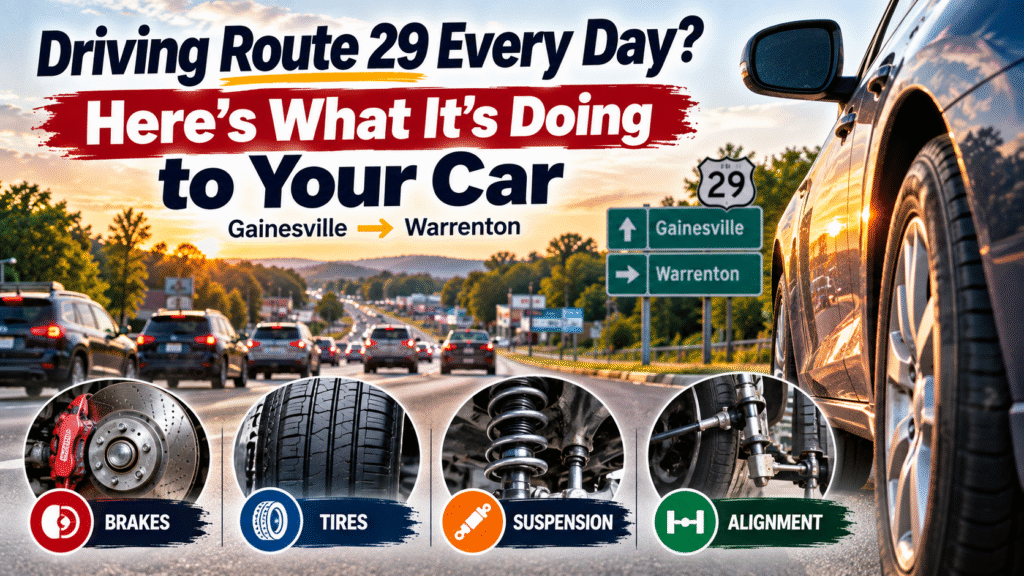
Why Route 29 Is Harder on Vehicles Than a Normal Highway Commute
Many drivers assume that a long commute is easier on a vehicle than short city driving.
Sometimes that is true.
Steady highway driving allows the engine, transmission, brakes, and tires to operate under relatively consistent conditions.
Route 29, however, is not a completely steady highway commute.
Drivers regularly move between slow traffic, traffic lights, acceleration zones, construction bottlenecks, and open sections where speeds increase again.
That repeated change in speed creates stress.
Every time you slow down approaching a traffic light, the braking system converts the vehicle’s movement into heat. When traffic begins moving again, the engine and transmission work to bring the vehicle back up to speed.
Suspension components are also constantly reacting to road imperfections, braking forces, acceleration, and lane changes.
One commute may not seem significant.
But after hundreds of trips, those repeated cycles add up.
For daily Route 29 commuters, the wear is often gradual enough that drivers do not notice a problem until a tire has already developed uneven wear or the brakes begin making noise.
Brake Wear Is One of the Most Common Problems
Brake repairs are among the most common services we see from drivers traveling between Gainesville and Warrenton.
The reason is simple: frequent stopping creates more friction and heat.
A driver traveling on an uninterrupted highway may go several miles without touching the brake pedal. A Route 29 commuter may brake repeatedly during the same distance because of traffic lights, congestion, turning vehicles, and changing traffic speeds.
Over time, brake pads naturally become thinner.
Repeated heat cycles can also affect brake rotors.
Drivers may begin noticing squealing, steering wheel shake during braking, pulsation in the brake pedal, or longer stopping distances.
These symptoms should not automatically be treated as an emergency, but they should not be ignored either.
A brake inspection can help determine whether normal wear is occurring or whether components need attention before more expensive damage develops.
Tire Wear and Alignment Problems Can Develop Quietly
Tires are another major expense for daily commuters.
One of the biggest problems with alignment wear is that it may happen slowly enough that the driver does not immediately feel a difference.
A pothole, rough section of pavement, or curb impact can move wheel alignment angles outside manufacturer specifications.
The vehicle may still drive relatively normally.
Meanwhile, one edge of the tire may begin wearing faster than the rest of the tread.
By the time the driver notices the problem, thousands of miles of tire life may already have been lost.
Seasonal temperature changes can make the problem worse.
Cold weather can reduce tire pressure, while warmer temperatures can increase it. Drivers who do not check tire pressure regularly may unknowingly drive on underinflated tires.
Underinflated tires can generate additional heat and wear more quickly.
For commuters, regular tire pressure checks, rotations, and alignment inspections can help protect tire life.
Suspension Components Also Take a Beating
Route 29 may look smooth in many areas, but suspension systems experience thousands of small impacts over time.
Ball joints, tie rods, control arms, shocks, struts, bushings, and other steering and suspension components are constantly working to keep the tires in contact with the road.
Potholes, pavement transitions, construction areas, and rough road edges can accelerate wear.
Early suspension symptoms may include clunking sounds over bumps, loose steering, vehicle wandering, uneven tire wear, or a change in handling.
A worn suspension component can also affect alignment.
That means an alignment alone may not solve the problem if the underlying mechanical component is loose or damaged.
This is why suspension inspection and alignment diagnosis should often be considered together.
Seasonal Conditions Create Additional Stress
Northern Virginia weather can create unique maintenance challenges.
Winter temperature swings affect tire pressure and place additional demands on batteries and fluids.
Freeze-thaw cycles can also damage pavement.
Water enters cracks, freezes, expands, and gradually breaks apart the road surface.
By spring, potholes and rough pavement often become more common.
A driver may remember one large pothole impact, but the real wear may come from dozens of smaller impacts experienced over weeks or months.
Summer brings another challenge.
Long traffic backups combined with high temperatures can increase demands on the cooling system.
Engines may spend extended periods idling while air conditioning and electrical accessories continue operating.
Vehicles with aging cooling-system components may begin showing problems during these conditions.
How We Inspect Commuter Vehicles at Advanced Automotive
When a vehicle used for daily Route 29 commuting comes into Advanced Automotive, we look beyond the immediate complaint.
A vibration may be caused by a tire issue, wheel balance problem, suspension component, or bearing concern.
Uneven tire wear may indicate alignment drift, worn steering parts, or suspension problems.
Brake noise may be related to worn pads, rotor condition, or another component in the braking system.
Our inspection process may include evaluating the complete brake system, tire tread depth, alignment angles, steering components, suspension parts, fluids, and cooling system condition.
The goal is to understand the cause of the problem rather than simply replacing the first component that appears worn.
Finding developing problems early can also help reduce repair costs.
A worn suspension component discovered before it damages a set of tires can save money.
A brake problem caught before rotor damage develops may also be less expensive to repair.
Warning Signs Route 29 Commuters Should Watch For
Your vehicle often gives you small clues before a larger problem develops.
A new vibration at highway speed may indicate a tire, balance, steering, or suspension issue.
If the vehicle begins pulling to one side, the alignment or tire condition may need to be checked.
Squealing or pulsation during braking can indicate brake wear.
Clunking sounds over bumps may point toward suspension components.
Uneven tire wear is another important sign because it can indicate alignment or steering problems before the vehicle becomes difficult to drive.
Excessive bouncing after bumps may suggest worn shocks or struts.
Dashboard warning lights should also be investigated instead of simply ignored.
The biggest mistake many drivers make is waiting until the vehicle becomes uncomfortable or unsafe to drive before having it inspected.
Earlier diagnosis usually gives you more options.
Planning for Repair Costs
Repair costs vary depending on the vehicle, parts required, and severity of wear.
Brake repairs may cost several hundred dollars per axle.
A complete set of tires can cost several hundred dollars or more depending on the vehicle and tire type.
Wheel alignments are generally much less expensive than tire replacement, which is why catching alignment problems early can make financial sense.
Suspension repairs can range from a relatively minor component replacement to more extensive work costing over a thousand dollars.
Luxury and heavy-duty vehicles may cost more because of specialized parts and labor requirements.
At Advanced Automotive, we provide an estimate before repairs begin so customers understand what is being recommended and why.
The Bottom Line for Gainesville-to-Warrenton Commuters
The Route 29 commute is not extreme, but it creates a combination of driving conditions that can gradually accelerate wear.
Frequent braking affects brake components. Road impacts can change alignment angles. Tire pressure fluctuations and rough pavement can shorten tire life. Suspension components absorb constant impacts, while traffic and summer heat can place additional demands on the cooling system.
The good news is that most of these problems usually provide warning signs before becoming major failures.
A small vibration, slight pull, unusual brake noise, or uneven tire wear may be your vehicle’s way of telling you that something needs attention.
If you drive between Gainesville and Warrenton every day and something about your vehicle feels different, having it inspected early can help prevent a smaller issue from becoming a larger repair.
At Advanced Automotive, every repair is backed by our 12-month / 12,000-mile warranty on parts and labor. We also offer free towing with qualifying repairs and free pickup and delivery throughout the Gainesville and Warrenton area.
Call us at (703) 665-1818 or visit 13380 University Blvd, Gainesville, VA.
We also serve Warrenton, Haymarket, Bristow, Manassas, and surrounding Northern Virginia communities.
Our goal is simple: identify the real problem early, explain it clearly, and help keep your vehicle dependable for the commute ahead.
 Oil Change Gainesville
 Auto Brake Repair Gainesville, VA
  Towing Services Gainesville
  Fleet Services Gainesville
  Virginia Safety & Emissions Inspections
  Air Conditioning & Heating
  Wheel Alignment Warrenton
  Vehicle Diagnostic
  Auto Transmission Repair