

 Locations
 Hours
 Call Us Now
 Book Appointment


Finding a reliable auto repair shop isn’t always easy. When your check engine light comes on, your brakes start making unusual noises, or your vehicle begins vibrating on the highway, you want more than a quick repair. You want an experienced mechanic who can identify the problem, explain the findings, and recommend only the services your vehicle actually needs.
At Advanced Automotive in Gainesville, VA, we understand that trust is one of the most important parts of automotive service.
I’m Donnie, owner of Advanced Automotive. For more than 35 years, we’ve focused on a straightforward philosophy diagnose first, explain the findings, and repair only what is necessary.
Whether you’re commuting along Interstate 66, driving through Warrenton, or traveling on Route 29, our goal is to help keep your vehicle safe and dependable without unnecessary repair expenses.
Here’s a closer look at how our automotive diagnostic process works.
Why Accurate Automotive Diagnostics Matter
Modern vehicles contain complex mechanical, electrical, and computer-controlled systems. When something goes wrong, the symptoms don’t always reveal the actual cause.
For example, a check engine light could indicate anything from a relatively minor sensor problem to a more significant engine performance issue.
Similarly, a vehicle that won’t start may have a weak battery, a faulty starter, poor electrical connections, or another electrical problem.
Replacing components without identifying the underlying issue can waste money and leave the original problem unresolved.
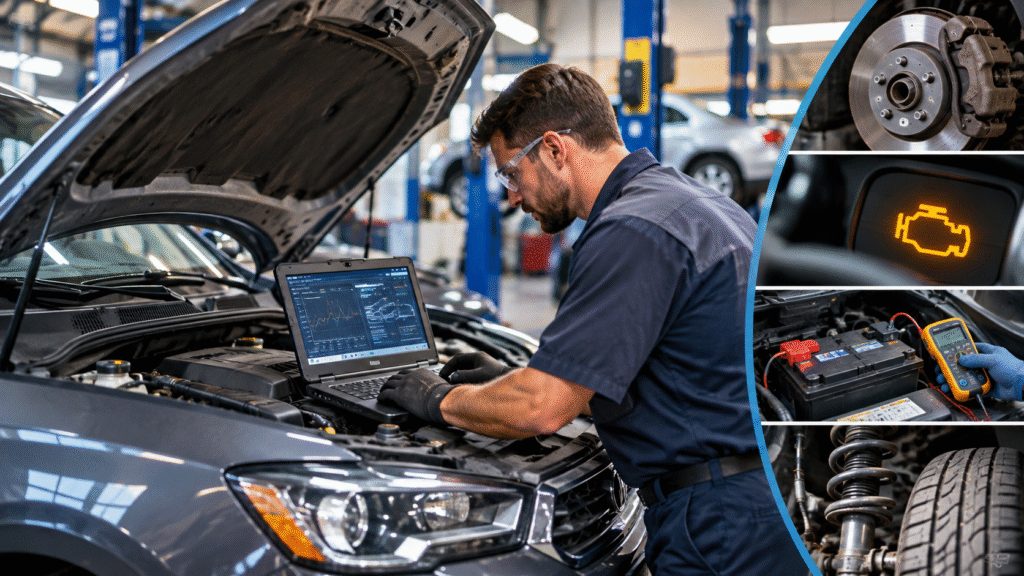
That’s why professional auto diagnostics in Gainesville, VA, should involve careful inspection, appropriate testing, and accurate interpretation of results.
At Advanced Automotive, we believe understanding the problem is the first step toward fixing it correctly.
Step 1: Listening to Your Vehicle Concerns
Every successful diagnosis begins with understanding what the driver is experiencing.
When you bring your vehicle to our shop, our technicians take time to discuss the symptoms.
We may ask when the problem started, whether it occurs during acceleration or braking, and if certain driving conditions make it worse.
For example, a vibration that appears only at highway speeds may require a different diagnostic approach than one occurring while braking.
Similarly, an unusual noise during cold starts can suggest different possibilities than a noise that develops after the engine warms up.
These details help our technicians identify which systems require closer examination.
You don’t need advanced automotive knowledge to explain the issue. Simply describing what you notice can provide valuable diagnostic information.
Step 2: Verifying the Problem
Before recommending repairs, our technicians work to confirm the reported symptoms.
This may involve a visual inspection, road test, computer scan, or additional mechanical testing.
Some problems are easy to reproduce, while others occur intermittently.
For instance, a vehicle might only hesitate after extended driving, or an electrical warning light may appear occasionally.
In these situations, identifying the problem may require reviewing stored diagnostic information or testing the vehicle under specific operating conditions.
Our approach focuses on collecting evidence before deciding which components need attention.
This helps reduce unnecessary repairs and supports more reliable results.
Step 3: Using Professional Computer Diagnostics
Today’s vehicles rely heavily on onboard computer systems that monitor engine performance, emissions, transmission operation, and other functions.
When something operates outside expected parameters, the vehicle may store a diagnostic trouble code.
However, a trouble code doesn’t automatically identify the component that needs replacement.
For example, a code related to a lean fuel mixture could result from several conditions, including a vacuum leak, intake system problem, inaccurate sensor readings, or insufficient fuel pressure.
A diagnostic scanner provides important information, but the technician must interpret that information alongside physical testing and vehicle performance data.
At Advanced Automotive, our ASE-certified technicians use professional diagnostic equipment and hands-on experience to investigate the underlying cause.
This allows us to make informed repair recommendations rather than relying on fault codes alone.
Step 4: Testing Components Before Replacing Them
One of the most important principles of our repair process is testing before replacement.
Consider a vehicle with a repeatedly discharged battery.
The obvious assumption might be that the alternator needs replacing.
However, testing could reveal that the alternator and battery are functioning properly.
The actual problem might involve an electrical accessory remaining active after the vehicle is turned off, a wiring issue, or a parasitic battery drain.
Replacing a functioning alternator wouldn’t solve these problems.
Instead, our technicians inspect the relevant electrical systems to determine what is causing the battery to lose power.
This evidence-based approach applies to engine problems, braking systems, suspension concerns, electrical faults, and other automotive repairs.
Accurate diagnostics help protect customers from spending money on parts they don’t need.
Step 5: Prioritizing Safety, Maintenance, and Future Repairs
Not every issue discovered during an inspection requires immediate attention.
At Advanced Automotive, we help customers understand their vehicle’s condition by organizing recommendations into three categories.
Safety-Related Repairs
These involve problems that may affect safe vehicle operation, including severely worn brakes, damaged steering components, unsafe tires, or significant suspension failures.
Such concerns deserve prompt attention because delaying repairs could increase safety risks.
Recommended Maintenance
Routine maintenance helps support vehicle reliability and performance.
Examples include fluid services, filter replacement, spark plugs, belt inspections, and manufacturer-recommended maintenance.
These services are evaluated according to vehicle condition, mileage, and maintenance requirements.
Future Maintenance Considerations
Some components show normal wear but don’t require immediate replacement.
In these situations, we explain the condition and recommend monitoring or reassessment during a future service visit.
This allows customers to plan maintenance expenses without feeling pressured into unnecessary work.
Step 6: Explaining Diagnostic Findings Clearly
We believe customers should understand why a repair is being recommended.
Whenever practical, our technicians explain inspection findings using photographs, measurements, diagnostic results, or visual examples.
This may include showing worn brake components, identifying fluid leaks, explaining tire wear, or reviewing relevant computer diagnostic information.
Rather than simply presenting a repair estimate, we explain the concern and discuss available options.
Our goal is to help customers make confident, informed decisions about their vehicles.
Clear communication is especially important when a repair involves expensive components or complex electrical systems.
Understanding Local Driving Conditions in Gainesville, VA
Northern Virginia driving conditions can place additional demands on vehicles.
Heavy traffic along Interstate 66 frequently involves repeated braking and acceleration.
Road construction, uneven surfaces, and potholes can contribute to tire, wheel, alignment, and suspension concerns.
Drivers regularly commuting between Gainesville, Warrenton, Haymarket, Bristow, and Manassas may also accumulate significant mileage.
These conditions can influence maintenance needs and component wear.
Our familiarity with local driving patterns helps us evaluate vehicles with practical, real-world operating conditions in mind.
Whether you drive a Ford, Toyota, Honda, Chevrolet, Subaru, BMW, or another vehicle, proper inspections can help identify developing problems before they become more expensive.
How Much Does Professional Auto Diagnosis Cost?
Diagnostic costs depend on the vehicle, symptoms, testing requirements, and complexity of the problem.
At Advanced Automotive, most initial diagnostic inspections typically range from $100 to $200.
More complicated electrical faults, intermittent problems, or advanced drivability concerns may require additional testing.
Before proceeding with further diagnostics or recommended repairs, our team explains the work involved and provides an estimate.
We believe customers deserve transparency when making decisions about automotive repairs.
Why Drivers Choose Advanced Automotive
For more than 35 years, Advanced Automotive has served drivers throughout Gainesville and surrounding Northern Virginia communities.
Our approach combines experienced ASE-certified technicians, professional diagnostic equipment, and clear communication.
We focus on finding the actual problem instead of recommending replacements without supporting evidence.
Qualifying repairs are backed by our 12-month/12,000-mile warranty on parts and labor, providing additional confidence in our services.
Whether you need check engine light diagnostics, brake inspections, electrical troubleshooting, or general auto repair, our team is committed to dependable service.
Schedule Professional Auto Diagnostics in Gainesville, VA
If your vehicle is making unusual noises, displaying warning lights, vibrating, or performing differently than normal, professional diagnosis can help identify the cause.
Ignoring these warning signs may allow smaller problems to develop into more significant repairs.
At Advanced Automotive, we’re committed to helping you understand your vehicle’s condition and make informed repair decisions without unnecessary pressure.
Visit: Advanced Automotive
Address: 13380 University Blvd, Gainesville, VA 20155
Phone: (703) 665-1818
We proudly serve Gainesville, Warrenton, Haymarket, Bristow, Manassas, Centreville, and nearby Northern Virginia communities.
Contact Advanced Automotive today for professional vehicle diagnostics and straightforward auto repair recommendations.
 Oil Change Gainesville

 Auto Brake Repair Gainesville, VA
 Towing Services Gainesville
 Fleet Services Gainesville
 Virginia Safety & Emissions Inspections
 Air Conditioning & Heating
 Wheel Alignment Warrenton
 Vehicle Diagnostic
 Auto Transmission Repair