

 Locations
 Hours
Hours Call Us Now
 Book Appointment


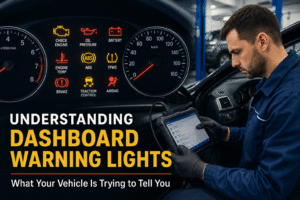
Modern vehicles are equipped with advanced technology designed to keep drivers safe and informed. One of the most important communication tools in your vehicle is the dashboard warning light system. While many drivers ignore these lights or assume they are minor issues, dashboard warning lights are your vehicle’s way of telling you that something needs attention.
Ignoring a warning light can turn a simple repair into a costly mechanical failure. Understanding what these lights mean and knowing how to respond can help you avoid expensive repairs, improve vehicle safety, and extend the life of your car.
Why Dashboard Warning Lights Are Important
Dashboard warning lights are connected to your vehicle’s onboard computer system, which continuously monitors the performance of critical components. When the system detects a problem, it alerts you by illuminating a warning light on the dashboard.
These warning lights help drivers identify potential issues before they become serious. Addressing them early can prevent unexpected breakdowns, improve fuel efficiency, protect your engine, and reduce overall repair costs.
Understanding Dashboard Warning Light Colors
Not all dashboard warning lights indicate the same level of urgency. Their colors help drivers understand how serious the issue is.
Green or Blue Warning Lights
Green and blue lights generally indicate that a system is operating normally. These lights simply provide information to the driver.
Common examples include:
- High Beam Indicator
- Cruise Control
- Eco Mode
- Turn Signal Indicators
These lights do not usually require any action.
Yellow or Amber Warning Lights
Yellow or amber warning lights indicate that your vehicle has detected an issue that should be inspected soon. Although your vehicle may still be safe to drive, delaying repairs could allow the problem to worsen.
Common yellow warning lights include:
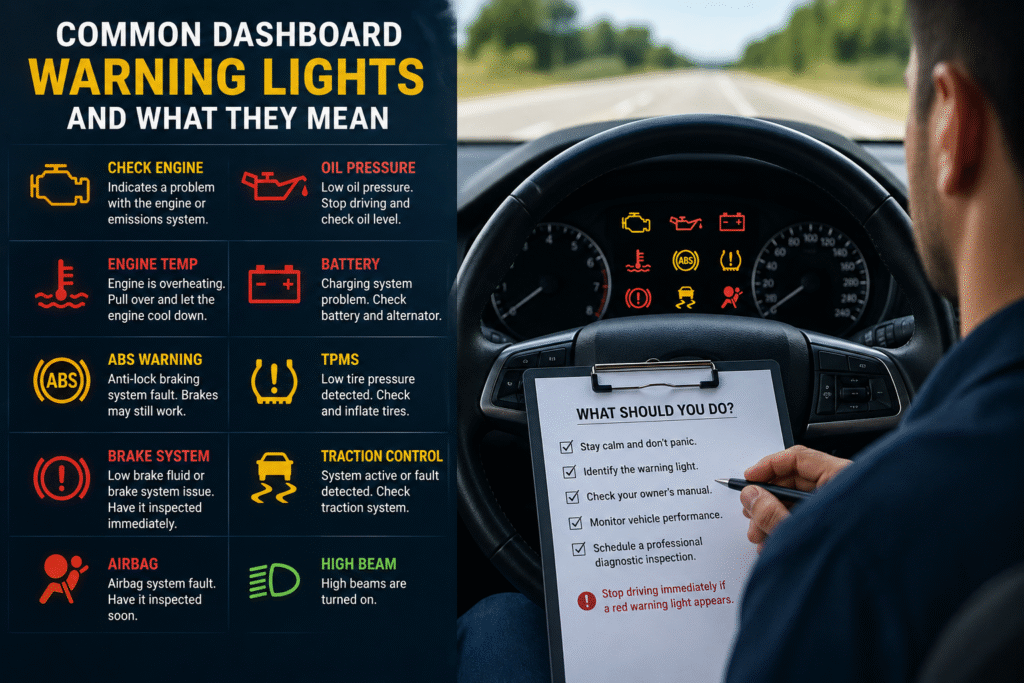
- Check Engine Light
- Tire Pressure Monitoring System (TPMS)
- ABS Warning Light
- Traction Control Light
If any of these lights remain illuminated, schedule a professional vehicle inspection as soon as possible.
Red Warning Lights
Red warning lights indicate serious problems that require immediate attention. Continuing to drive could result in severe vehicle damage or create unsafe driving conditions.
Common red warning lights include:
- Oil Pressure Warning
- Engine Temperature Warning
- Brake System Warning
- Battery Charging Warning
If you notice a red warning light, pull over safely, turn off the engine if necessary, and have your vehicle inspected immediately.
Common Dashboard Warning Lights Explained
Check Engine Light
The Check Engine Light is one of the most common—and most misunderstood—dashboard indicators.
It can be triggered by several issues, including:
- Loose or damaged gas cap
- Faulty oxygen sensor
- Ignition system problems
- Emissions system faults
- Fuel system issues
- Engine performance concerns
A solid Check Engine Light usually indicates a problem that should be diagnosed soon. However, if the light is flashing, stop driving immediately, as it may indicate severe engine misfires that can cause expensive engine damage.
Professional diagnostics can accurately identify the root cause rather than replacing parts unnecessarily.
Oil Pressure Warning Light
Many drivers mistake the oil pressure warning light as simply a reminder for an oil change. In reality, this warning indicates that your engine may not be receiving sufficient oil pressure.
Possible causes include:
- Low engine oil
- Oil pump failure
- Oil pressure sensor malfunction
- Internal engine damage
Driving with low oil pressure can destroy an engine within minutes. If this light appears, safely pull over, switch off the engine, check the oil level, and seek professional assistance immediately.
Engine Temperature Warning Light
The engine temperature warning light signals that your engine is overheating.
Common causes include:
- Low coolant level
- Coolant leaks
- Faulty thermostat
- Water pump failure
- Radiator issues
- Cooling fan malfunction
If your engine overheats, pull over immediately and turn off the engine. Never remove the radiator cap while the engine is still hot, as it can cause serious burns.
Ignoring engine overheating may result in blown head gaskets and expensive engine repairs.
Battery Warning Light
Many people believe the battery warning light simply means the battery needs replacing. However, it usually indicates a problem with the vehicle’s charging system.
Possible causes include:
- Faulty alternator
- Loose battery terminals
- Damaged wiring
- Weak battery
- Drive belt problems
Without proper charging, your vehicle may eventually lose electrical power and stop running.
Tire Pressure Monitoring System (TPMS) Light
The TPMS warning light alerts you when one or more tires have low air pressure.
Low tire pressure can affect:
- Fuel economy
- Tire lifespan
- Vehicle handling
- Braking performance
Seasonal temperature changes often trigger this warning. Always check your tire pressure using a reliable gauge and inflate tires according to the manufacturer’s recommendations.
ABS Warning Light
The Anti-lock Braking System (ABS) helps maintain steering control during emergency braking.
When the ABS warning light appears:
- Standard braking may still work.
- Anti-lock braking assistance may be disabled.
- Emergency braking performance may be reduced.
Have your braking system inspected as soon as possible to maintain safe driving.
Brake Warning Light
The brake warning light should never be ignored because it directly affects vehicle safety.
Possible causes include:
- Low brake fluid
- Worn brake pads
- Hydraulic brake problems
- Parking brake engaged
If the light remains on after releasing the parking brake, schedule an inspection immediately.
Traction Control Warning Light
The traction control system improves vehicle stability during slippery road conditions.
This warning may indicate:
- Wheel speed sensor issues
- ABS system faults
- Stability control problems
- Temporary loss of traction
If the light stays on continuously, professional diagnostics are recommended.
Airbag Warning Light
Your vehicle’s airbags are essential safety features.
If the airbag warning light remains illuminated, it may indicate:
- Sensor failure
- Wiring problems
- Airbag control module malfunction
- Seatbelt pretensioner issues
Ignoring this warning could prevent airbags from deploying correctly during an accident.
What Should You Do When a Warning Light Appears?
If a warning light appears on your dashboard:
- Stay calm and avoid panic.
- Identify which warning light is illuminated.
- Refer to your owner’s manual if you’re unsure what it means.
- Monitor how the vehicle is performing.
- Schedule a professional diagnostic inspection.
- Stop driving immediately if a red warning light appears.
Taking prompt action often prevents larger, more expensive repairs.
Why Professional Vehicle Diagnostics Matter
Modern vehicles use sophisticated computer systems that require specialized diagnostic equipment. Simply clearing a warning light does not solve the underlying issue.
Professional technicians can:
- Identify the exact problem
- Recommend the correct repair
- Prevent unnecessary parts replacement
- Help avoid future breakdowns
Early diagnosis not only saves money but also improves your vehicle’s safety and reliability.
Final Thoughts
Dashboard warning lights are designed to protect both your vehicle and your wallet. Whether it’s a Check Engine Light, Oil Pressure Warning, Battery Light, TPMS warning, or Brake System Alert, every warning deserves immediate attention.
Ignoring these indicators can lead to expensive repairs, unexpected breakdowns, and unsafe driving conditions. Understanding what each warning light means and acting quickly can save you time, money, and unnecessary stress.
If your dashboard warning light comes on, don’t wait until the problem gets worse. Visit Advanced Automotiveva. for professional vehicle diagnostics and expert auto repair services.
📍 Advanced Automotiveva.
13380 University Blvd,
Gainesville, VA 20155
📞 Call: (703) 665-1818
We proudly serve drivers in Gainesville, Haymarket, Bristow, Manassas, Warrenton, Centreville, Chantilly, Aldie, South Riding, Leesburg, Sterling, Nokesville, Fairfax, Marshall, The Plains, Middleburg, and Culpeper.
Let our ASE-Certified technicians help keep your vehicle safe, reliable, and road-ready.
 Oil Change Gainesville
 Auto Brake Repair Gainesville, VA
  Towing Services Gainesville
  Fleet Services Gainesville
  Virginia Safety & Emissions Inspections
  Air Conditioning & Heating
  Wheel Alignment Warrenton
  Vehicle Diagnostic
  Auto Transmission Repair