

 Locations
 Hours
Hours Call Us Now
 Book Appointment


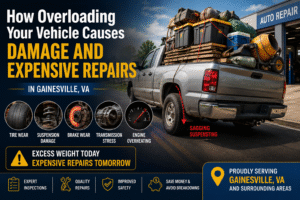
Every vehicle is built to carry a specific amount of weight safely. Whether you’re transporting construction equipment, moving furniture, hauling landscaping materials, or packing for a family vacation, exceeding your vehicle’s recommended weight limit can have serious consequences. While many drivers assume their vehicle can handle “just a little extra weight,” overloading puts excessive strain on critical components, leading to expensive repairs, reduced fuel efficiency, and compromised safety.
At Advanced Automotive, we regularly inspect vehicles suffering from premature wear caused by carrying loads beyond their designed capacity. Overloaded vehicles not only cost more to maintain but also become increasingly dangerous to drive, especially during sudden stops, sharp turns, or adverse weather conditions.
If you frequently carry heavy cargo around Gainesville, Haymarket, Manassas, Warrenton, or the surrounding Northern Virginia communities, understanding the risks of overloading can help you avoid costly mechanical failures and extend the life of your vehicle.
What Does It Mean to Overload a Vehicle?
A vehicle is considered overloaded when the combined weight of passengers, cargo, tools, equipment, towing loads, and accessories exceeds the manufacturer’s Gross Vehicle Weight Rating (GVWR).
Every manufacturer carefully calculates how much weight a vehicle can safely support while maintaining proper handling, braking, suspension performance, and structural integrity. This information is usually found:
- Inside the driver’s side door jamb
- In the owner’s manual
- On the manufacturer’s certification label
Driving above the recommended weight limit forces nearly every mechanical system to work harder than intended, accelerating wear and increasing the likelihood of expensive breakdowns.
Why Vehicle Overloading Is More Serious Than Most Drivers Think
Many people believe that if their vehicle still moves normally, everything is fine. Unfortunately, that’s not true.
The damage caused by excessive weight often happens gradually. Components experience increased stress every time you accelerate, brake, turn, or drive over uneven roads. Even though the damage isn’t immediately visible, it slowly shortens the lifespan of expensive parts throughout the vehicle.
Overloading can affect:
- Suspension system
- Tires
- Brake system
- Steering components
- Transmission
- Engine
- Wheel alignment
- Fuel economy
Eventually, these problems combine to create unsafe driving conditions and repair bills that could have been avoided.
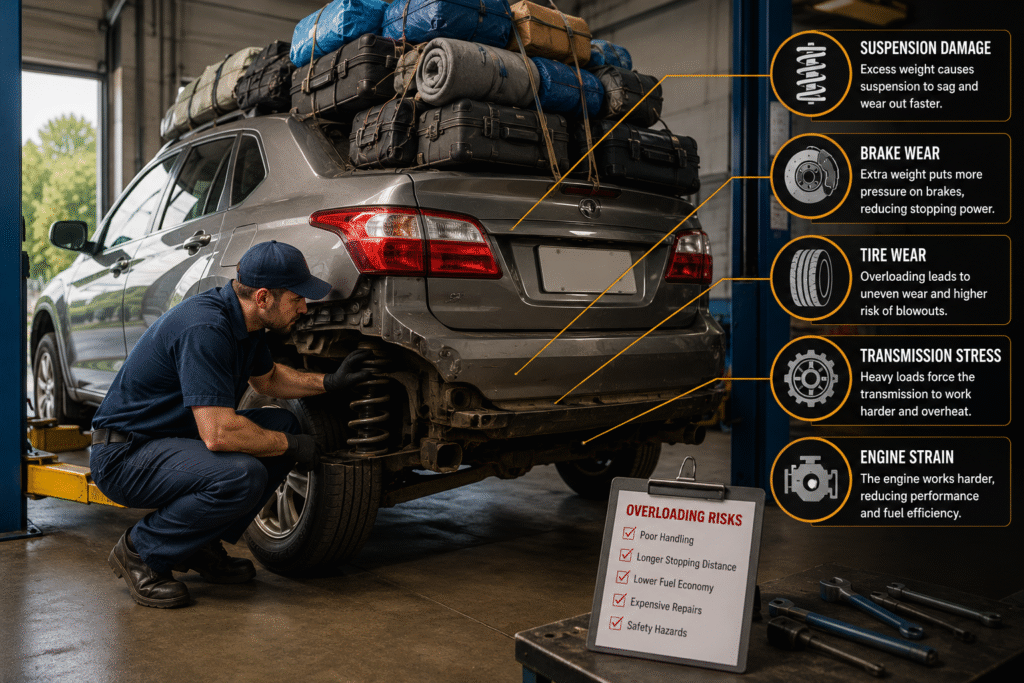
Excess Weight Places Extreme Stress on Your Suspension
Your suspension system is responsible for supporting the weight of the vehicle while keeping the tires firmly planted on the road. It also absorbs bumps, maintains ride comfort, and helps drivers retain control during turns and emergency maneuvers.
When a vehicle is overloaded, shocks, struts, springs, bushings, and control arms are forced to absorb much greater loads than they were designed for.
Over time, this can cause:
- Premature shock absorber failure
- Broken or sagging springs
- Worn suspension bushings
- Damaged control arms
- Reduced ride height
- Poor handling
Drivers often notice that the vehicle begins to lean, bounce excessively, or feel unstable during cornering. Left unchecked, suspension damage can become expensive and negatively affect many other systems.
Overloaded Tires Wear Out Much Faster
Your tires are the only part of your vehicle that contacts the road, and they are engineered to support a specific load.
When excessive weight is added, tire pressure alone cannot compensate for the additional stress. The extra load creates more heat inside the tire, weakens the internal structure, and accelerates tread wear.
Common tire problems caused by overloading include:
- Uneven tread wear
- Sidewall bulging
- Excessive heat buildup
- Tire separation
- Blowouts
- Reduced traction
This becomes particularly dangerous during hot summer months or long highway trips, when tire temperatures naturally rise even under normal driving conditions.
Overloading Significantly Increases Brake Wear
Brakes convert your vehicle’s motion into heat to bring it safely to a stop. When the vehicle weighs more than intended, the brakes must generate much more stopping force every time you slow down.
This additional workload causes:
- Faster brake pad wear
- Rotor overheating
- Brake fade
- Warped brake rotors
- Increased stopping distances
- Burning brake odors
In busy traffic around Gainesville, Fairfax, Centreville, or Chantilly, longer stopping distances can dramatically increase the risk of collisions.
Your Transmission Must Work Harder
The transmission transfers engine power to the wheels. Carrying excessive weight forces the transmission to operate under constant heavy loads.
Over time this may result in:
- Transmission overheating
- Hard shifting
- Premature clutch wear
- Fluid breakdown
- Internal gear damage
Transmission repairs are among the most expensive automotive repairs, making prevention far less costly than replacement.
Heavy Loads Put Extra Stress on the Engine
Your engine must produce additional horsepower to move extra weight.
The harder the engine works, the more fuel it consumes and the more heat it generates.
Continuous overloading may lead to:
- Increased fuel consumption
- Higher operating temperatures
- Cooling system strain
- Premature engine wear
- Reduced engine efficiency
Over time, these conditions shorten engine life and increase maintenance costs.
Poor Fuel Economy Is One of the First Warning Signs
Many drivers first notice overloading through decreased fuel efficiency.
More weight means:
- Increased rolling resistance
- Higher engine workload
- More fuel burned
- More frequent fuel stops
Even moderate overloading over several months can significantly increase annual fuel costs.
Steering and Vehicle Handling Become Less Stable
Vehicle engineers carefully balance steering, braking, suspension, and weight distribution to maximize safety.
Excessive weight disrupts this balance, causing:
- Heavy steering
- Slower steering response
- Increased body roll
- Poor cornering stability
- Reduced emergency maneuverability
These problems become even more dangerous during rain, snow, or emergency lane changes.
Overloading Can Affect Wheel Alignment
Every additional pound carried by your vehicle places greater stress on suspension geometry.
Over time, overloaded suspension components gradually shift alignment angles, leading to:
- Uneven tire wear
- Vehicle pulling left or right
- Off-center steering wheel
- Reduced fuel economy
- Poor handling
Routine wheel alignment inspections can help identify these problems before they become costly.
Warning Signs Your Vehicle May Be Carrying Too Much Weight
Many drivers unknowingly overload their vehicles.
Watch for these common warning signs:
- The vehicle sits noticeably lower than normal.
- Tires appear compressed or have bulging sidewalls.
- Braking distances increase.
- Steering feels unusually heavy.
- Acceleration becomes sluggish.
- The vehicle sways during turns.
- Fuel economy suddenly decreases.
If you notice any of these symptoms, reducing the load and scheduling a professional inspection is recommended.
How to Prevent Overloading Damage
Fortunately, preventing overload-related damage is straightforward.
Here are a few simple steps:
- Always check your vehicle’s GVWR.
- Know your payload capacity before loading cargo.
- Distribute weight evenly throughout the vehicle.
- Never exceed towing limits.
- Maintain proper tire pressure.
- Schedule regular maintenance inspections.
- Upgrade suspension components if your vehicle regularly carries heavy work equipment.
Following these recommendations can dramatically extend the life of your vehicle while reducing maintenance expenses.
Why Regular Vehicle Inspections Matter
If your vehicle frequently transports heavy tools, trailers, construction equipment, landscaping supplies, or commercial cargo, regular inspections become even more important.
Professional inspections allow technicians to identify early signs of wear before they become major mechanical failures.
At Advanced Automotive, our ASE-certified technicians inspect:
- Suspension systems
- Brake components
- Steering systems
- Tires
- Wheel alignment
- Cooling systems
- Transmission performance
- Drivetrain components
Routine inspections save money by preventing small problems from becoming expensive repairs.
Trust Advanced Automotive for Reliable Vehicle Care in Gainesville, VA
For more than 35 years, Advanced Automotive has helped drivers throughout Gainesville and Northern Virginia keep their vehicles safe, reliable, and performing at their best.
Whether your vehicle is used for daily commuting, commercial work, towing, or transporting heavy equipment, our experienced technicians provide honest recommendations, advanced diagnostics, and high-quality repairs tailored to your vehicle’s needs.
We proudly serve drivers from Gainesville, Haymarket, Bristow, Manassas, Warrenton, Nokesville, Centreville, Fairfax, Chantilly, Aldie, South Riding, Sterling, Leesburg, Marshall, The Plains, Middleburg, and Culpeper.
If your vehicle regularly carries heavy loads or you’ve noticed changes in handling, braking, suspension performance, or tire wear, don’t wait until a small issue becomes a costly repair.
Schedule a comprehensive vehicle inspection with Advanced Automotive today and let our expert technicians help keep your vehicle safe, efficient, and road-ready for every journey.
Schedule Your Vehicle Inspection at Advanced Automotive Today
If your vehicle frequently carries heavy loads, tows trailers, or transports equipment, regular inspections can help detect problems early and prevent expensive repairs. At Advanced Automotive, our ASE-certified technicians provide thorough inspections and expert repair services to keep your vehicle safe, reliable, and performing at its best.
Whether you need suspension repairs, brake service, wheel alignment, tire inspections, transmission diagnostics, or routine maintenance, our experienced team is here to help.
Visit Us
Advanced Automotive
13380 University Blvd
Gainesville, VA 20155
📞 Phone: (703) 665-1818
We proudly serve drivers throughout Gainesville, Haymarket, Bristow, Manassas, Warrenton, Nokesville, Centreville, Fairfax, Chantilly, Aldie, South Riding, Sterling, Leesburg, Marshall, The Plains, Middleburg, and Culpeper.
Contact Advanced Automotive today to schedule your vehicle inspection and keep your car running safely and efficiently for years to come.
 Oil Change Gainesville
 Auto Brake Repair Gainesville, VA
  Towing Services Gainesville
  Fleet Services Gainesville
  Virginia Safety & Emissions Inspections
  Air Conditioning & Heating
  Wheel Alignment Warrenton
  Vehicle Diagnostic
  Auto Transmission Repair