

 Locations
 Hours
Hours Call Us Now
 Book Appointment


Modern vehicles are smarter than ever before. Unlike older cars that relied mainly on mechanical systems, today’s vehicles use advanced computer technology to monitor engine performance, fuel efficiency, emissions, and dozens of other critical systems every second you drive. When something isn’t functioning properly, your car’s onboard computer can often detect the issue before it turns into a costly repair.
If you’ve ever wondered, “How does my car know something is wrong?”, the answer lies in modern engine diagnostics.
At Advanced Automotive in Gainesville, VA, we help drivers quickly identify vehicle problems using professional diagnostic equipment and experienced ASE-certified technicians. Whether your check engine light has appeared or your vehicle simply isn’t performing as it should, accurate diagnostics are the first step toward reliable repairs.
What Are Engine Diagnostics?
Engine diagnostics is the process of connecting specialized diagnostic equipment to your vehicle’s onboard computer system to identify mechanical or electrical issues.
Modern vehicles contain multiple electronic control modules that constantly monitor important systems, including:
- Engine performance
- Fuel delivery
- Ignition timing
- Transmission operation
- Emissions system
- Cooling system
- Exhaust system
- Air intake
- Sensor performance
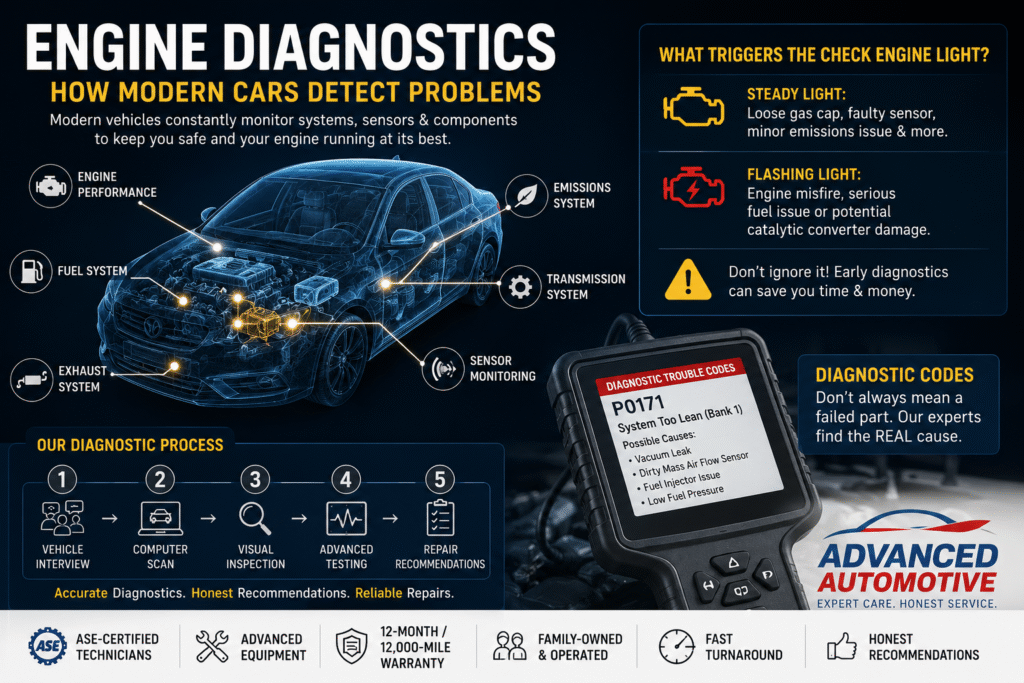
Whenever one of these systems operates outside the manufacturer’s specifications, the vehicle stores a Diagnostic Trouble Code (DTC). In many cases, it also activates the Check Engine Light, alerting the driver that professional attention may be needed.
Professional diagnostics allow technicians to retrieve these codes and accurately determine what’s causing the problem.
How Modern Vehicles Detect Problems
Every vehicle manufactured since 1996 is equipped with an OBD-II (On-Board Diagnostics II) system. This system continuously monitors hundreds of vehicle functions using various sensors placed throughout the engine and drivetrain.
Some of the most important sensors include:
- Oxygen Sensors
- Mass Air Flow (MAF) Sensor
- Crankshaft Position Sensor
- Camshaft Position Sensor
- Coolant Temperature Sensor
- Knock Sensor
- Throttle Position Sensor
- Fuel Pressure Sensor
Each sensor sends real-time information to the Engine Control Module (ECM). If any reading falls outside the acceptable range, the ECM records a diagnostic trouble code and may illuminate the Check Engine Light.
Think of the OBD-II system as your vehicle performing a continuous health check every time you drive.
Understanding the Check Engine Light
The Check Engine Light is one of the most common dashboard warning lights—and one of the most misunderstood.
A Steady Check Engine Light
A steady light often indicates a less urgent issue, such as:
- Loose or damaged gas cap
- Faulty oxygen sensor
- Minor emissions system problem
- Sensor malfunction
Although the vehicle may still be drivable, it’s important to schedule diagnostics as soon as possible to prevent the issue from worsening.
A Flashing Check Engine Light
A flashing Check Engine Light usually signals a more serious problem, including:
- Engine misfire
- Severe fuel system issue
- Potential catalytic converter damage
If the light is flashing, reduce driving immediately and arrange for professional diagnostic testing. Continuing to drive may lead to expensive engine or exhaust repairs.
Diagnostic Trouble Codes Don’t Always Identify the Failed Part
Many people assume that a diagnostic code directly tells technicians which part needs replacing. In reality, a fault code simply points toward the affected system.
For example, a P0171 code indicates that the engine is running lean. However, several different issues could be responsible, including:
- Vacuum leaks
- Weak fuel pump
- Dirty Mass Air Flow Sensor
- Fuel injector problems
- Intake manifold leaks
Replacing parts without proper testing often leads to unnecessary expenses and unresolved problems.
At Advanced Automotive, our technicians perform thorough diagnostic procedures to identify the actual cause before recommending any repairs.
Common Signs Your Vehicle Needs Engine Diagnostics
Your vehicle doesn’t always need to display a Check Engine Light before it develops problems.
If you notice any of the following symptoms, professional diagnostics are recommended:
- Reduced fuel economy
- Rough idle
- Slow acceleration
- Engine hesitation
- Hard starting
- Stalling
- Excessive exhaust smoke
- Strange engine noises
- Failed emissions inspection
Early diagnosis can help prevent larger, more expensive repairs in the future.
How Advanced Automotive Performs Engine Diagnostics
Professional engine diagnostics involve much more than plugging in a scanner.
Our comprehensive diagnostic process includes several important steps.
Step 1: Customer Consultation
We begin by discussing:
- Vehicle symptoms
- Driving conditions
- When the problem occurs
- Recent maintenance or repairs
This information often provides valuable clues.
Step 2: Computer Diagnostic Scan
Using advanced diagnostic equipment, we connect directly to your vehicle’s OBD-II system to retrieve:
- Stored fault codes
- Pending fault codes
- Live sensor data
- System performance information
These readings help narrow down the possible causes.
Step 3: Visual Inspection
Our ASE-certified technicians carefully inspect:
- Electrical wiring
- Connectors
- Belts
- Hoses
- Vacuum lines
Many issues can be identified during this stage without unnecessary part replacement.
Step 4: Advanced System Testing
When additional testing is needed, we perform procedures such as:
- Fuel pressure testing
- Smoke testing for vacuum leaks
- Sensor performance analysis
- Electrical system testing
- Component activation testing
These tests help confirm the exact source of the problem.
Step 5: Honest Repair Recommendations
Once we’ve identified the issue, we explain:
- What failed
- Why it failed
- Available repair options
- Estimated repair costs
Our goal is complete transparency and only recommending repairs your vehicle actually needs.
Why Professional Engine Diagnostics Save You Money
Many vehicle owners search online for fault codes and immediately replace the suggested component. Unfortunately, this approach often results in unnecessary expenses because the original problem remains unresolved.
Professional diagnostics help you:
- Avoid replacing good parts
- Detect hidden issues early
- Reduce repair costs
- Improve fuel economy
- Prevent unexpected breakdowns
- Extend engine life
Accurate diagnostics provide the foundation for efficient and cost-effective vehicle repairs.
Can Engine Diagnostics Prevent Major Repairs?
Absolutely.
Many expensive engine failures begin as relatively small problems that could have been corrected early.
| Small Problem | Potential Major Repair |
|---|---|
| Faulty Oxygen Sensor | Catalytic Converter Damage |
| Coolant Temperature Sensor Failure | Engine Overheating |
| Fuel Trim Issue | Reduced Engine Performance and Damage |
Routine diagnostic inspections allow technicians to identify developing issues before they become major mechanical failures.
Why Drivers in Gainesville Trust Advanced Automotive
For more than 35 years, Advanced Automotive has provided trusted automotive repair and diagnostic services to drivers throughout:
- Gainesville
- Haymarket
- Bristow
- Manassas
- Warrenton
- Nokesville
- Centreville
- Chantilly
- Fairfax
- Aldie
- South Riding
- Sterling
- Leesburg
- Marshall
- Middleburg
- The Plains
- Culpeper
Customers continue to choose us because we offer:
- ASE-Certified Technicians
- Advanced Diagnostic Equipment
- Honest Repair Recommendations
- Family-Owned Customer Service
- 12-Month / 12,000-Mile Warranty
- Comfortable Waiting Area
- Fast Turnaround Times
Rather than replacing parts based on assumptions, we focus on accurately identifying the root cause of every vehicle issue.
Schedule Professional Engine Diagnostics in Gainesville, VA
If your Check Engine Light is illuminated, your vehicle isn’t performing as expected, or you simply want peace of mind before a small issue becomes a major repair, Advanced Automotive is here to help.
Our experienced technicians provide comprehensive engine diagnostics and complete automotive repair services for drivers throughout Gainesville and the surrounding communities.
Advanced Automotive
13380 University Blvd
Gainesville, VA
📞 Call: (703) 665-1818
Whether your vehicle needs a simple sensor replacement or in-depth diagnostic testing, our team will identify the problem, explain your options clearly, and get you safely back on the road.
 Oil Change Gainesville
 Auto Brake Repair Gainesville, VA
  Towing Services Gainesville
  Fleet Services Gainesville
  Virginia Safety & Emissions Inspections
  Air Conditioning & Heating
  Wheel Alignment Warrenton
  Vehicle Diagnostic
  Auto Transmission Repair