

 Locations
 Hours
 Call Us Now
 Book Appointment


You walk toward your car on a typical morning in Gainesville, VA, and notice a small puddle underneath it. At first, you might assume it’s simply water dripping from the air conditioning system.
But what if that puddle is actually engine coolant?
A coolant leak may seem like a minor inconvenience, but ignoring it can lead to overheating, expensive repairs, and potentially serious engine damage.
At Advanced Automotive in Gainesville, VA, we’ve spent more than 35 years helping local drivers identify and repair vehicle cooling system problems before they become major mechanical failures.
Understanding the warning signs of a coolant leak can help you protect your engine and avoid unexpected breakdowns.
What Happens When Your Car Leaks Coolant?
Your vehicle’s cooling system plays an essential role in maintaining a safe engine operating temperature.
As your engine runs, it generates significant heat. Coolant circulates through the engine, absorbs excess heat, and carries it to the radiator, where that heat is released.
The cooled fluid then returns to the engine, repeating the process.
When a leak develops, the system gradually loses coolant. Without enough coolant, the engine may struggle to maintain its normal temperature.
Over time, this can cause overheating, damage to engine components, and costly mechanical problems.
Even a small leak deserves attention because cooling system problems often become worse with continued driving.
Common Causes of Coolant Leaks
Coolant leaks can develop in several areas of your vehicle’s cooling system.
Some of the most common causes include:
- Damaged radiator hoses: Rubber hoses can deteriorate over time due to heat, pressure, and age.
- Cracked radiators: Radiator components may develop cracks that allow coolant to escape.
- Water pump problems: Worn seals or damaged components can cause coolant leakage.
- Faulty thermostat housings: Cracks or damaged gaskets can lead to coolant loss.
- Loose hose connections: Clamps and fittings may loosen, allowing fluid to leak.
- Damaged coolant reservoirs: Plastic expansion tanks can become brittle and develop cracks.
- Head gasket problems: Internal engine damage may allow coolant to enter areas where it doesn’t belong.
Not every coolant leak creates a visible puddle.
Some leaks occur internally, making professional diagnosis especially important.
How to Identify a Coolant Leak
Recognizing the early warning signs of coolant loss can help prevent more serious engine damage.
Colored Fluid Under Your Vehicle
Engine coolant may appear green, orange, yellow, pink, or another color depending on the product used.
A colored puddle beneath your vehicle could indicate a cooling system leak.
However, fluid color alone cannot confirm the problem. Professional inspection helps identify the leaking substance accurately.
Sweet Smell Near the Engine
Many engine coolants produce a distinctive sweet odor.
If you notice this smell around your vehicle, particularly after driving, coolant may be escaping onto warm engine components.
Rising Engine Temperature
An increasing temperature gauge is one of the most important warning signs.
If the engine temperature approaches the red zone, pull over safely and switch off the engine.
Continuing to drive an overheating vehicle can cause severe damage.
Repeated Low Coolant Warnings
If you regularly need to refill your coolant reservoir, the system may have an active leak.
Adding coolant repeatedly without identifying the cause does not solve the underlying problem.
Why Gainesville Driving Conditions Can Affect Cooling Systems
Driving conditions around Gainesville and Northern Virginia can place additional demands on your vehicle’s cooling system.
During the summer, high temperatures combined with heavy traffic can make engine temperature management more challenging.
Drivers traveling along I-66, Route 29, or University Boulevard may experience extended periods of stop-and-go traffic.
When vehicles move slowly, less natural airflow passes through the radiator, increasing reliance on electric cooling fans.
Long commutes, air conditioning usage, and heavily loaded vehicles can place additional demands on the engine.
If your cooling system already has a weakness, these conditions may make the problem more noticeable.
That’s why regular cooling system inspections are particularly valuable for drivers who commute frequently or take long road trips.
How Professional Coolant Leak Diagnosis Works
At Advanced Automotive, diagnosing a coolant leak involves identifying the actual source of the problem rather than simply replacing the first suspicious component.
Visual Inspection
The process begins by checking for visible coolant leakage, damaged hoses, cracks, and signs of fluid contamination.
Technicians also examine the coolant reservoir, radiator, and surrounding components.
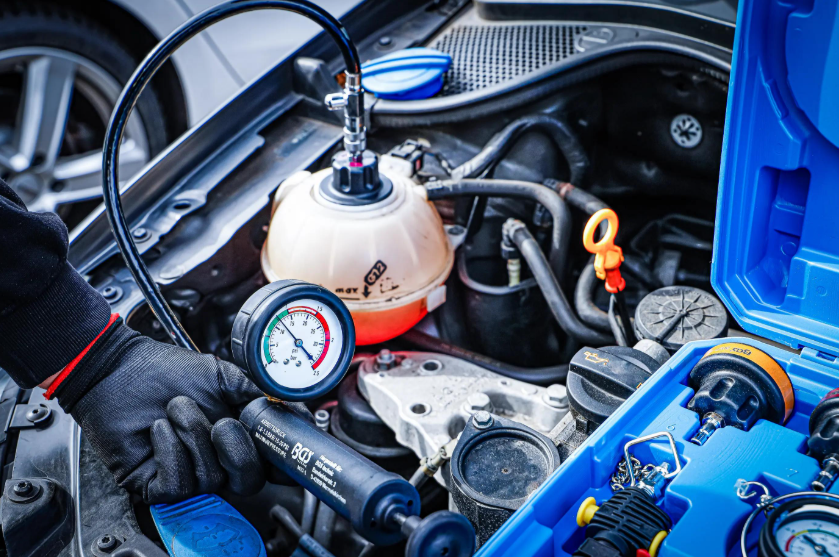
Cooling System Pressure Testing
Pressure testing helps identify leaks that may not appear during a basic visual inspection.
With the engine safely cooled, specialized equipment applies controlled pressure to the cooling system.
This allows technicians to locate small leaks in radiators, hoses, water pumps, and other components.
Component Inspection
The cooling system includes several interconnected parts.
Technicians may inspect the radiator, thermostat, water pump, cooling fans, reservoir, and connecting hoses to evaluate their condition.
Internal Leak Testing
If coolant levels continue dropping without visible external leakage, further testing may be necessary.
Internal coolant loss can sometimes indicate head gasket damage or other serious engine problems.
A proper diagnosis helps determine which repairs are necessary and prevents unnecessary replacement of functioning components.
When Should You Stop Driving?
Certain cooling system symptoms require immediate attention.
If you notice steam coming from beneath the hood, a rapidly rising temperature gauge, or severe overheating warnings, stop driving as soon as it is safe.
Turn off the engine and allow it to cool.
Never open a hot radiator cap because pressurized coolant can cause serious burns.
If the vehicle has overheated or cannot maintain a safe operating temperature, arranging professional towing is safer than continuing to drive.
Responding quickly can reduce the risk of major engine damage.
How Much Does Coolant Leak Repair Cost?
Coolant leak repair costs depend on the damaged component, vehicle model, labor requirements, and whether overheating has caused additional problems.
Typical estimated repair ranges include:
- Radiator hose replacement: $150–$350
- Thermostat replacement: $250–$500
- Radiator replacement: $500–$1,200+
- Water pump replacement: $500–$1,500+
These are general estimates, not guaranteed repair prices.
A professional inspection is necessary to determine the actual repair requirements.
Addressing a minor cooling system problem early is often considerably less expensive than repairing an engine damaged by repeated overheating.
Preventing Future Cooling System Problems
Regular vehicle maintenance can help reduce the likelihood of unexpected coolant leaks.
Follow your vehicle manufacturer’s recommended coolant replacement schedule and use the specified coolant type.
Pay attention to unusual engine temperatures, changing coolant levels, and visible signs of leakage.
Periodic cooling system inspections can also help identify aging hoses, worn seals, and damaged components before they fail.
Before long road trips, particularly during hot weather, checking the cooling system is a sensible precaution.
Preventive maintenance cannot eliminate every mechanical problem, but it can improve reliability and help drivers identify issues sooner.
Protect Your Engine with Advanced Automotive in Gainesville, VA
A small coolant puddle may be the first warning sign of a developing cooling system problem.
Ignoring it can put your engine at risk, particularly during heavy traffic, summer heat, or long-distance driving.
At Advanced Automotive, we’ve helped Gainesville-area drivers maintain their vehicles for more than 35 years.
Our goal is to identify the source of cooling system problems, explain the recommended repairs clearly, and help customers make informed maintenance decisions.
We serve drivers throughout Gainesville, Warrenton, Haymarket, Bristow, Manassas, and surrounding Northern Virginia communities.
Advanced Automotive
Address: 13380 University Blvd, Gainesville, VA
Phone: (703) 665-1818
If you’ve noticed coolant beneath your vehicle, recurring low coolant warnings, or unusual engine temperatures, contact Advanced Automotive for a professional cooling system inspection.
Final Thoughts
A coolant leak should never be dismissed simply because the puddle looks small.
Early diagnosis, proper repairs, and routine cooling system maintenance can help prevent overheating and costly engine damage.
Protecting your engine starts with recognizing warning signs and addressing problems before they become emergencies.
 Oil Change Gainesville

 Auto Brake Repair Gainesville, VA
 Towing Services Gainesville
 Fleet Services Gainesville
 Virginia Safety & Emissions Inspections
 Air Conditioning & Heating
 Wheel Alignment Warrenton
 Vehicle Diagnostic
 Auto Transmission Repair