

 Locations
 Hours
 Call Us Now
 Book Appointment


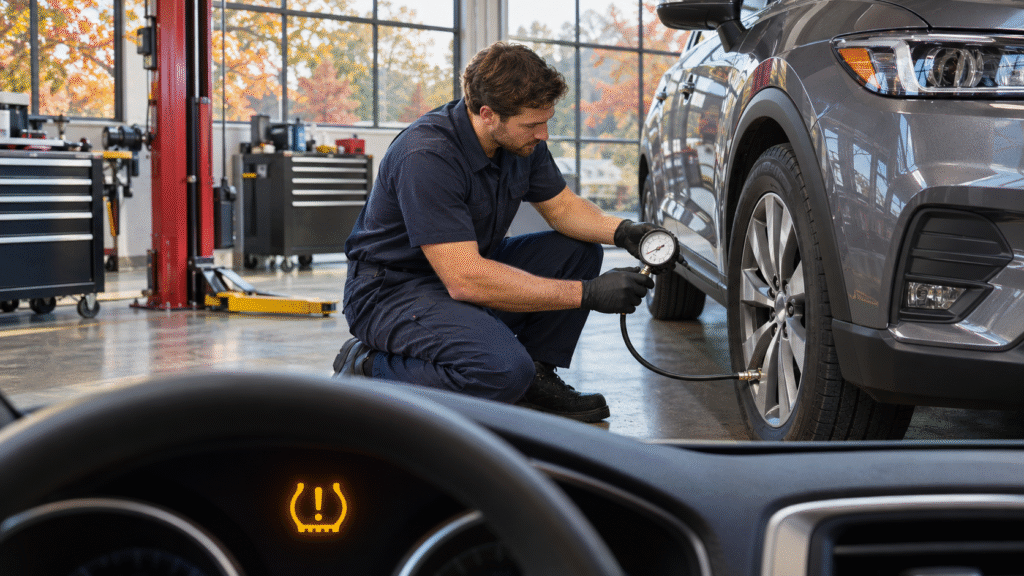
You’re driving east on I-66 after leaving Linton Hall Road when a small yellow symbol appears on your dashboard: a horseshoe-shaped icon with an exclamation point. Your Tire Pressure Monitoring System (TPMS) light has turned on.
Your first thought may be, “Did I run over a nail?” You might wonder whether it’s safe to keep driving or whether you need new tires. The warning can be unsettling, but it doesn’t always mean you have a flat. It does mean your tires need attention.
I’m Donnie, owner of Advanced Automotive in Gainesville. For more than 35 years, we’ve helped drivers across Northern Virginia with tire and vehicle concerns. Every fall, winter, and spring, we hear the same question: “Why is my tire pressure light on?”
The answer could be a change in temperature, a slow leak, a problem with a valve stem, or a faulty TPMS sensor. Knowing what to look for can help you respond safely and avoid unnecessary repairs.
What the Tire Pressure Warning Light Means
Many drivers assume the TPMS light means a tire is flat. That’s one possibility, but it isn’t the only one.
Your vehicle’s TPMS monitors tire pressure and alerts you when one or more tires fall below the recommended level. In many vehicles, the warning comes on when pressure is significantly low. The system tells you there may be a problem, but it doesn’t identify the cause.
The most common reasons include:
- Cold weather lowering tire pressure
- A nail or screw causing a slow leak
- Air escaping around the tire bead or valve stem
- A TPMS sensor that needs service or replacement
Even if the warning light goes away later, don’t assume the issue has fixed itself. Tires can warm up as you drive or as the weather changes, causing the pressure reading to rise. A slow leak may still be present.
Why Gainesville’s Weather Can Trigger the Light
Northern Virginia weather can shift quickly. Around Gainesville, overnight lows and afternoon highs may differ considerably, especially during seasonal changes.
As the outside temperature drops, the air inside your tires contracts and pressure decreases. A tire that was already slightly underinflated can fall below the level that triggers the warning after a cold night.
Drivers may notice the light on the way to work, then see it disappear after driving for a while. That can happen as the tires warm up. But the higher reading doesn’t necessarily mean the tire is back to the correct pressure. The temperature change may simply have revealed that the tire was low to begin with.
Construction activity in Gainesville, Haymarket, and Bristow can also contribute to tire problems. Nails, screws, and other sharp debris sometimes end up on local roads. A small screw can lodge in the tread and let air escape slowly, even when the tire looks normal from the outside.
How to Check Your Tires
When the warning light comes on, check all four tires as soon as it’s safe to do so. Look for a tire that appears visibly low, damage to the tread or sidewall, or an object embedded in the tire. Don’t remove a nail or screw yourself; taking it out can make a leak worse.
Use a reliable pressure gauge to check each tire. Compare the readings with the manufacturer’s recommended pressure, which is usually listed on a label inside the driver’s door frame or in the owner’s manual. The number printed on the tire’s sidewall is generally the tire’s maximum pressure, not the recommended pressure for your vehicle.
If you don’t have a gauge or aren’t sure what the readings mean, have a professional inspect the tires. Adding air may turn off the warning, but it won’t fix a puncture, leaking valve stem, damaged wheel, or failed sensor.
How We Diagnose a TPMS Warning
At Advanced Automotive, we look for the reason the pressure dropped rather than simply adding air and sending you on your way. An inspection may include checking the pressure in all four tires, examining the tread and sidewalls, and looking for leaks around the wheel bead and valve stem.
We also test the TPMS sensors and check tire wear patterns. Uneven wear can point to chronic underinflation or an alignment concern. In some cases, the tire has a small puncture that’s been leaking for days or weeks. In others, a sensor may have reached the end of its service life. TPMS sensor batteries commonly last several years, but their lifespan varies by vehicle and driving conditions.
The distinction matters: a sensor issue doesn’t automatically mean the tire needs replacement. If a repair is needed, we’ll explain what we found and provide an estimate before doing the work.
Repairs are backed by our 12-month/12,000-mile warranty on parts and labor. We also offer free towing with repair and free local pickup and delivery throughout Gainesville and nearby areas. AAA members may qualify for additional benefits.
When to Stop Driving
A TPMS warning doesn’t always mean you need emergency service, but certain signs call for immediate attention. If a tire looks visibly flat, is losing air quickly, or the vehicle begins pulling to one side, find a safe place to stop. Changes in steering or handling can indicate that a tire is dangerously underinflated.
A flashing TPMS light that then stays on may indicate a sensor or system fault. A steady light often points to low pressure, though the cause still needs to be checked. If the light returns repeatedly after you add air, there may be a leak.
Driving on a significantly underinflated tire can damage its sidewall in a short distance. A puncture that might have been repairable can become a tire replacement if the tire is driven while too low. When in doubt, avoid driving on a visibly damaged or flat tire.
What Might the Repair Cost?
The cost depends on what caused the warning. Sometimes the tire only needs to be inflated to the correct pressure. Other repairs may involve fixing a puncture, replacing a valve stem, servicing a TPMS sensor, or replacing a tire that can’t be safely repaired.
A small puncture repair typically costs less than a new tire, while a failed sensor can often be addressed without replacing the tire. The right repair depends on the tire’s condition and the location and extent of any damage. We’ll explain the findings and discuss the options before beginning work.
Get the Warning Checked Before It Gets Worse
A tire pressure warning can be caused by something simple, such as cold weather or low pressure. It can also point to a slow leak or a sensor problem. Checking it promptly helps protect your tires and gives you a clearer idea of what your vehicle needs.
After more than 35 years serving Gainesville and Northern Virginia, we’ve seen how a quick inspection can catch small problems before they become costly repairs. If your tire pressure light is on, stop by Advanced Automotive. We’ll inspect the tires, explain what’s happening, and help you decide what to do next.
Call (703) 665-1818 or visit 13380 University Blvd, Gainesville, VA 20155. We serve Gainesville, Haymarket, Bristow, Manassas, Warrenton, and surrounding Northern Virginia communities. No appointment is needed for most tire inspections.
 Oil Change Gainesville

 Auto Brake Repair Gainesville, VA
 Towing Services Gainesville
 Fleet Services Gainesville
 Virginia Safety & Emissions Inspections
 Air Conditioning & Heating
 Wheel Alignment Warrenton
 Vehicle Diagnostic
 Auto Transmission Repair