

 Locations
 Hours
Hours Call Us Now
 Book Appointment


If you regularly drive from Gainesville to Warrenton along Rt. 29, your daily commute may be putting more stress on your vehicle than you realize. Stop-and-go traffic, frequent braking, acceleration, lane changes, construction zones, potholes, and changing road conditions can gradually accelerate wear on several important vehicle components.
At first, the signs may be easy to overlook. Your car may still start normally, the steering may feel fine, and the transmission may shift without any obvious problems. Then you may notice a small vibration at 55 mph, a hesitation when leaving a stoplight, a brake squeal during your morning commute, or an unfamiliar clunk when driving over a bump.
These symptoms are often early warnings that your vehicle needs attention.
After more than 35 years of automotive repair experience in Northern Virginia, Advanced Automotive has seen recurring wear patterns among drivers traveling between Gainesville, Warrenton, Haymarket, Bristow, and surrounding communities. The important thing is not simply that commuter vehicles wear out, but that the type of driving they experience can make certain repairs more predictable.
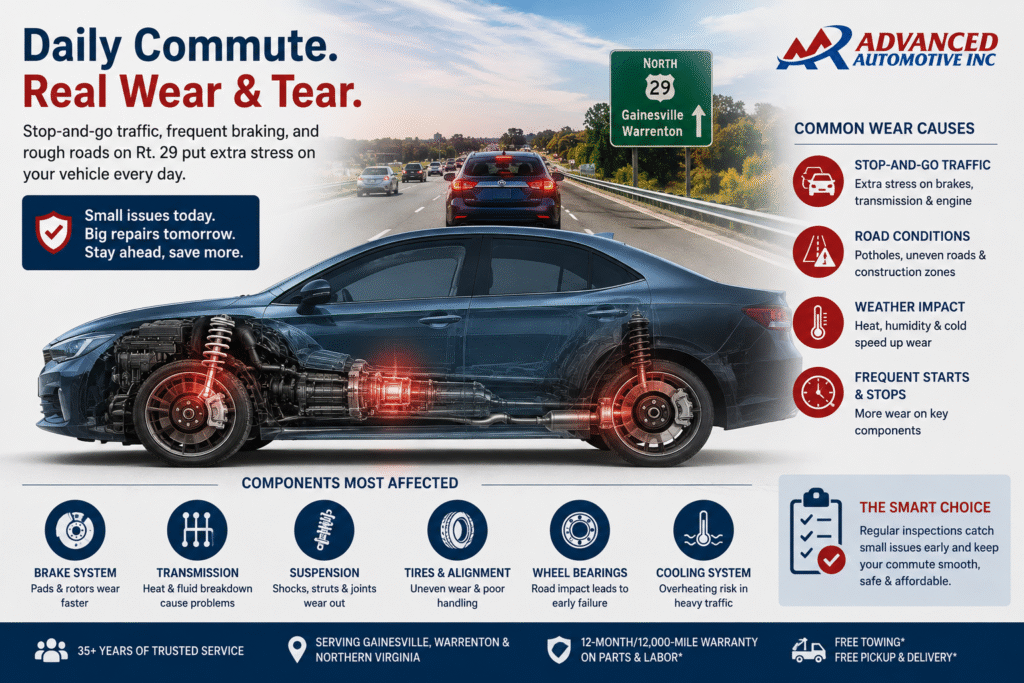
Why Rt. 29 Commuting Can Be Hard on Your Vehicle
Many drivers assume that highway driving is relatively easy on a vehicle. That can be true when you’re traveling at a consistent speed with minimal braking and acceleration. However, the daily Rt. 29 commute is often very different.
Drivers experience repeated cycles of acceleration, braking, slowing down, stopping at traffic lights, changing lanes, and dealing with traffic congestion. Each cycle places additional stress on vehicle components.
Over time, these repeated stress cycles can contribute to premature wear.
The most common issues seen in commuter vehicles include:
- Premature brake wear
- Transmission overheating and fluid breakdown
- Suspension component wear
- Tire alignment problems
- Wheel bearing failures
- Engine cooling system issues
Mileage alone does not always tell the whole story. A vehicle with 80,000 miles of heavy stop-and-go commuting can experience significant wear compared with a vehicle that has accumulated 120,000 mostly-open-highway miles.
Why Gainesville and Warrenton Drivers Face Specific Wear Patterns
The Gainesville-to-Warrenton commute has its own combination of traffic and road conditions. Drivers leaving Gainesville may encounter congestion around I-66, Rt. 29, and Linton Hall Road before traffic conditions change again closer to Warrenton.
The repeated transition between low-speed traffic and moderate-speed driving can place additional demands on brakes and transmissions.
Weather also plays a role. During the summer, high temperatures combined with stop-and-go traffic can increase transmission temperatures and contribute to fluid breakdown. During winter, moisture and condensation can contribute to corrosion in brake and suspension components.
Construction and road development can create another source of wear. Dust, debris, potholes, uneven pavement transitions, and temporary road surfaces can affect shocks, struts, ball joints, tie rods, tires, and wheel alignment.
These conditions can make suspension and alignment inspections especially important for drivers who travel this route regularly.
The Most Common Repairs for Daily Commuters
Brake Wear
Repeated braking during heavy traffic can cause brake pads and rotors to wear faster than they would during steady-speed driving.
A squealing noise during your commute, changes in braking performance, or unusual vibrations can indicate that the braking system should be inspected. Addressing brake wear early can help prevent additional damage to other components.
Transmission Stress
Stop-and-go traffic can cause transmission temperatures to rise, particularly during hot weather. Over time, this can contribute to transmission fluid deterioration and increased wear.
A hesitation when accelerating from a stop, unusual shifting, or other changes in transmission behavior should not be ignored. Early diagnosis and proper maintenance can help prevent a minor issue from becoming a much more expensive transmission repair.
Suspension Problems
Potholes, uneven pavement, construction areas, and repeated road impacts can gradually wear suspension components.
Worn shocks, struts, sway bar links, ball joints, and tie rods can affect ride quality, handling, and tire wear. A clunking noise when driving over bumps or changes in how the vehicle handles may indicate that the suspension needs inspection.
Alignment and Tire Wear
A vehicle that pulls to one side or develops uneven tire wear may have an alignment problem. Suspension wear can also contribute to alignment changes.
Ignoring these signs can shorten tire life and create additional handling problems. An alignment inspection can help identify issues before they result in unnecessary tire replacement.
Cooling System Issues
The cooling system also deserves attention, particularly for vehicles that spend significant time in heavy traffic during hot Northern Virginia summers.
A cooling system problem can contribute to overheating, which may eventually affect other components, including the transmission and engine.
How Advanced Automotive Approaches Commuter Vehicle Repairs
When a commuter vehicle arrives at Advanced Automotive, the goal is not simply to replace the part associated with the customer’s complaint. The vehicle is evaluated as a complete system.
An inspection may include brake pad thickness, rotor condition, brake fluid quality, tire wear patterns, suspension components, steering linkage, transmission fluid condition, cooling system performance, alignment angles, and wheel bearings.
This approach is important because vehicle problems are often connected.
For example, uneven tire wear may be related to a worn suspension component. Premature brake wear could be associated with a sticking caliper. A transmission complaint may sometimes be connected to an overheating problem caused by another part of the vehicle.
Finding the underlying cause helps prevent unnecessary part replacement and allows the driver to make a more informed repair decision.
When repairs are recommended, Advanced Automotive explains what was found and provides an estimate before the work begins. Qualifying repairs are backed by a 12-month/12,000-mile warranty on parts and labor, with free towing with repair and free pickup and delivery available throughout the Gainesville and Warrenton area for many services.
Warning Signs Commuters Should Not Ignore
Small symptoms can be early indicators of larger problems. Drivers traveling Rt. 29 regularly should pay attention to changes such as:
- Brake squealing during morning commutes
- Steering wheel vibration at highway speeds
- Transmission hesitation when leaving a stoplight
- The vehicle pulling to one side
- Clunking sounds over bumps
- Burning smells after heavy traffic
- Uneven tire wear
- Intermittent dashboard warning lights
These symptoms do not automatically mean that a major repair is required. However, they are reasons to have the vehicle inspected before a small issue develops into a more expensive repair.
Preventive Maintenance Can Reduce Repair Costs
One of the biggest factors affecting repair costs is timing.
Replacing worn brake pads before they damage the rotors is generally less expensive than waiting until additional components are affected. Similarly, addressing a transmission fluid or cooling system issue early can help reduce the risk of eventually needing a complete transmission replacement.
Advanced Automotive notes that preventative maintenance generally costs less than reactive repairs. The shop provides estimates before work begins and helps customers prioritize repairs when several issues are discovered.
For daily Gainesville-to-Warrenton commuters, regular inspections can help identify developing problems before they become major breakdowns.
Keep Your Commuter Vehicle Ready for the Road
The biggest vehicle problems usually do not happen because of one bad commute. They develop through thousands of ordinary trips, repeated braking, road impacts, traffic congestion, temperature changes, and gradual component wear.
That is actually good news because identifying problems early can help reduce the possibility of expensive repairs later.
If you regularly drive between Gainesville and Warrenton, paying attention to unusual noises, vibrations, handling changes, warning lights, and braking or transmission behavior can make a significant difference.
Advanced Automotive has more than 35 years of experience servicing vehicles throughout Northern Virginia and serves drivers in Gainesville, Warrenton, Haymarket, Bristow, Manassas, and surrounding communities. The shop is located at 13380 University Blvd, Gainesville, VA. Drivers can call (703) 665-1818 for more information or visit the shop for most services without an appointment.
 Oil Change Gainesville
 Auto Brake Repair Gainesville, VA
  Towing Services Gainesville
  Fleet Services Gainesville
  Virginia Safety & Emissions Inspections
  Air Conditioning & Heating
  Wheel Alignment Warrenton
  Vehicle Diagnostic
  Auto Transmission Repair