

 Locations
 Hours
Hours Call Us Now
 Book Appointment


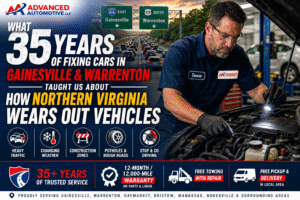
If you’ve driven through Gainesville or Warrenton during rush hour, you already know how demanding Northern Virginia can be on a vehicle. You may spend an hour crawling through traffic on I-66, repeatedly stopping and accelerating on Route 29, or navigating construction zones and uneven roads.
At first, these conditions may not seem like a major problem. Your vehicle continues to start, the brakes work, and the warning lights remain off. But small stresses can build up over time.
After more than 35 years of repairing vehicles in Gainesville, Warrenton, Haymarket, Bristow, Manassas, Nokesville, and surrounding communities, we’ve seen the same pattern repeatedly. A small issue gets ignored, routine maintenance is postponed, and eventually the vehicle needs a much more expensive repair.
I’m Donnie, owner of Advanced Automotive. Over the years, we’ve learned that Northern Virginia presents a unique combination of conditions that can accelerate vehicle wear. Understanding those conditions can help local drivers take better care of their vehicles and avoid unnecessary repair expenses.
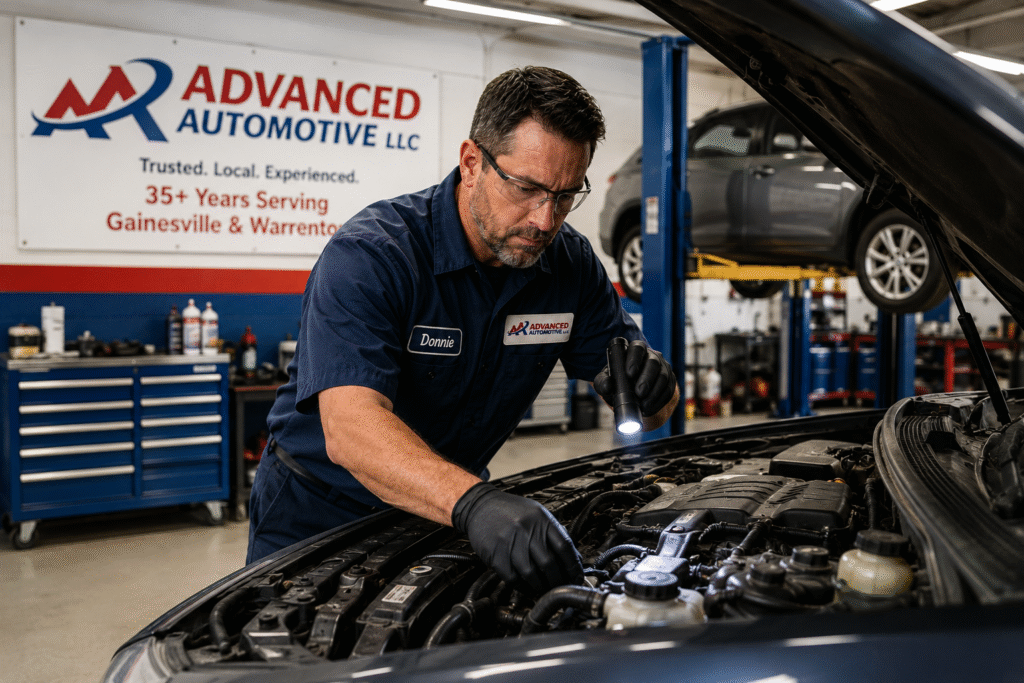
Why Northern Virginia Can Be Hard on Your Vehicle
Different parts of the country have different challenges for vehicles. Arizona has extreme heat, Michigan experiences heavy winter salt, and Florida has high humidity.
Northern Virginia has a little bit of everything.
Cold winter temperatures can put additional stress on batteries. Potholes and uneven roads can affect tires, suspension components, and wheel alignment. Summer traffic can increase heat and stress on vehicle systems. Construction zones can create additional braking and acceleration. Winter road treatments can contribute to corrosion.
None of these problems necessarily destroys a vehicle overnight.
Instead, they create repeated small stresses.
Think of your vehicle like a boxer going through a long fight. It isn’t necessarily one major hit that causes the damage. Thousands of smaller impacts and stresses eventually begin to take their toll.
That is why regular maintenance is so important for Northern Virginia drivers.
Gainesville Traffic Creates Additional Vehicle Stress
Gainesville has changed significantly over the past several decades. Residential development, construction, commuters, and increasing traffic have changed the way local vehicles are driven.
For many Gainesville drivers, daily commuting involves frequent stops and starts.
Stop-and-go traffic can be particularly demanding on brakes. Every traffic light requires another braking cycle. Traffic backups mean repeated acceleration and braking. Construction zones can create even more stopping, turning, and accelerating.
Over time, these driving conditions can contribute to faster brake wear and additional stress on tires, suspension components, and transmission systems.
Drivers who spend most of their time on open highways may experience different wear patterns compared with someone who spends every day commuting through heavy Gainesville traffic.
Understanding how your vehicle is actually being used is an important part of maintaining it properly.
Warrenton Drivers Face Different Road Challenges
Warrenton and the surrounding Fauquier County area present their own challenges.
Drivers who regularly travel on roads such as Waterloo Road, Meetze Road, and rural routes may encounter uneven pavement, potholes, seasonal road conditions, and longer driving distances.
These conditions can contribute to suspension and steering wear, tire damage, and alignment problems.
A vehicle may start pulling slightly to one side, develop uneven tire wear, or begin producing a noise over bumps. These symptoms may seem minor at first, but they can indicate an underlying problem.
Addressing these issues early can help prevent additional damage.
Cold weather can also expose weak batteries. A battery that seems fine during warmer months may struggle when temperatures suddenly drop during winter.
The Seven Vehicle Problems We See Most Often
After 35 years of automotive repair, several common patterns continue to appear.
1. Delayed Maintenance
One of the biggest mistakes drivers make is postponing routine maintenance.
Oil changes, fluid services, tire inspections, brake inspections, and other recommended services are designed to keep components working properly.
When maintenance is repeatedly delayed, small issues can eventually become expensive repairs.
2. Stop-and-Go Driving
Heavy traffic creates additional cycles of acceleration, braking, and idling.
Brakes can wear faster, transmission systems may experience additional heat, and engines spend more time operating without the vehicle moving at normal highway speeds.
For drivers with long daily commutes, regular inspections are especially important.
3. Ignoring Warning Lights
A warning light that disappears doesn’t necessarily mean the problem has disappeared.
Modern vehicles use computer systems to monitor numerous components. A warning light can provide an early indication that something needs attention.
Getting the vehicle properly diagnosed can help determine whether the issue is minor or requires immediate repair.
4. Choosing Low-Quality Parts
Saving money on replacement parts may seem attractive, but the cheapest option isn’t always the most economical choice.
Low-quality components may not provide the same durability or performance as quality replacement parts. Premature failure can also result in additional labor and repair costs.
5. Skipping Fluid Services
Engine oil isn’t the only fluid that matters.
Coolant, brake fluid, transmission fluid, and other fluids all play important roles in vehicle operation.
Fluids can deteriorate over time, and their condition should be monitored according to the manufacturer’s recommendations and the vehicle’s driving conditions.
6. Neglecting Tires
Your tires are the only parts of your vehicle that maintain direct contact with the road.
Incorrect tire pressure can affect handling, braking, fuel economy, and tire life.
Uneven tire wear may also indicate an alignment, suspension, or steering problem.
Regular tire inspections can help identify these issues before they become more serious.
7. Waiting for Inspection Time
Virginia State Inspection is important, but it shouldn’t be the only time your vehicle receives professional attention.
If a vehicle goes months without an inspection or maintenance check, several small problems may develop before they’re discovered.
Periodic inspections throughout the year can help identify developing problems earlier.
Why Preventive Maintenance Matters
Most vehicle owners don’t mind spending money when a repair is absolutely necessary.
The problem is that major repairs can sometimes be avoided by addressing smaller issues earlier.
For example, replacing a worn component may be considerably less expensive than waiting until that component fails and damages other parts.
The same principle applies to brakes, tires, cooling systems, suspension components, and other vehicle systems.
Preventive maintenance isn’t about repairing things that don’t need repair. It’s about identifying potential problems early and making informed decisions about what needs attention now and what can safely wait.
At Advanced Automotive, we believe customers deserve clear information before making a repair decision.
Our inspection process can include a digital vehicle health evaluation, brake inspection, tire analysis, suspension and steering evaluation, battery and charging system testing, cooling system inspection, fluid assessment, and transmission performance review.
The goal is to understand the overall condition of the vehicle rather than simply addressing one symptom.
What 35 Years of Experience Has Taught Us
After more than three decades of working on vehicles in Gainesville and Warrenton, one lesson stands out.
The drivers who generally have fewer major surprises aren’t necessarily the luckiest drivers.
They’re proactive.
They pay attention when their vehicle starts behaving differently. They don’t ignore warning lights. They maintain their tires. They follow recommended service intervals. And they address small problems before those problems have an opportunity to become larger ones.
Northern Virginia will continue to challenge vehicles. Traffic will remain part of daily commuting. Construction will continue. Weather will continue to change.
But drivers can control how they respond.
Regular maintenance and timely inspections can help you understand your vehicle’s condition and potentially prevent unexpected breakdowns.
Keep Your Vehicle Ready for Northern Virginia Roads
Whether you drive through Gainesville traffic every day, commute on I-66, travel around Warrenton, or regularly visit Haymarket, Bristow, Manassas, or Nokesville, your vehicle experiences conditions that can accelerate normal wear.
Advanced Automotive has been helping local drivers maintain and repair their vehicles for more than 35 years.
If you notice unusual noises, warning lights, brake problems, tire wear, transmission concerns, or changes in how your vehicle drives, don’t wait for the problem to become more expensive.
Visit Advanced Automotive at 13380 University Blvd, Gainesville, VA, or call (703) 665-1818.
We also offer free towing with repair and free pickup and delivery throughout much of the Gainesville and Warrenton area. Repairs are backed by a 12-month/12,000-mile warranty on parts and labor.
The goal isn’t simply to repair your vehicle today. It’s to help you understand what your vehicle needs so you can keep it reliable for the road ahead.
 Oil Change Gainesville
 Auto Brake Repair Gainesville, VA
  Towing Services Gainesville
  Fleet Services Gainesville
  Virginia Safety & Emissions Inspections
  Air Conditioning & Heating
  Wheel Alignment Warrenton
  Vehicle Diagnostic
  Auto Transmission Repair