

 Locations
 Hours
 Call Us Now
 Book Appointment


Winter in Northern Virginia can be unpredictable. One morning, you’re driving along I-66 in comfortable fall weather, and the next, you’re scraping frost off your windshield while your engine struggles to start.
For drivers in Gainesville, Haymarket, Manassas, and surrounding communities, preparing your vehicle before temperatures drop is essential for safety, reliability, and avoiding unexpected repair costs.
At Advanced Automotive, we understand how freezing temperatures, icy roads, and daily commuting affect your vehicle. With over 35 years of automotive repair experience, our team knows that winter often exposes mechanical problems that have been developing for months.
That’s why we recommend a comprehensive 9-point winter vehicle inspection before the first snowfall.
Why Winter Car Maintenance Matters in Northern Virginia
Cold weather places additional stress on several important vehicle components. Even a vehicle that performs perfectly during summer may experience problems when temperatures drop.
Common cold-weather challenges include:
- Reduced battery starting power
- Lower tire pressure and decreased traction
- Thickened engine oil during cold starts
- Increased stress on belts and hoses
- Reduced windshield visibility
- Cooling system and antifreeze problems
Tire pressure typically decreases by approximately one PSI for every 10°F temperature drop. Meanwhile, freezing temperatures can significantly reduce battery performance, particularly in older batteries.
These changes make preventive winter car maintenance in Gainesville, VA, especially important for commuters traveling on I-66, Route 29, and Route 28.
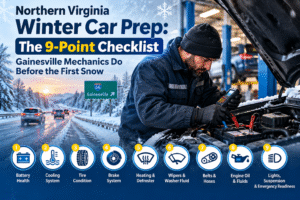
The Advanced Automotive 9-Point Winter Car Preparation Checklist
1. Test Your Car Battery
Your vehicle’s battery is one of the most vulnerable components during winter.
Cold temperatures reduce battery performance while increasing the power required to start your engine. A weak battery that works normally in October may fail during a freezing January morning.
At Advanced Automotive, technicians evaluate battery condition using professional testing equipment rather than relying solely on voltage readings.
A comprehensive battery inspection includes checking charging performance, terminal connections, corrosion, and overall battery health.
Expert Tip: If your battery is approaching three to five years old, consider having it tested before winter. Actual battery life depends on driving habits, climate, and maintenance.
2. Inspect the Cooling System and Antifreeze
Your cooling system does more than prevent overheating. During winter, it also protects your engine against freezing temperatures and internal corrosion.
Insufficient antifreeze protection can cause serious engine damage when temperatures fall below freezing.
Our technicians check coolant concentration, condition, hoses, radiator connections, and potential leaks.
We also verify that the cooling system provides adequate freeze protection according to your vehicle manufacturer’s recommendations.
A properly maintained cooling system supports efficient engine operation and reliable cabin heating.
3. Check Tire Tread, Pressure, and Overall Condition
Tires are your vehicle’s primary connection to the road. Their condition becomes particularly important when Northern Virginia experiences snow, freezing rain, or icy pavement.
Our tire inspection covers tread depth, uneven wear, sidewall damage, tire age, and inflation pressure.
Although Virginia’s minimum legal tread depth for passenger vehicles is generally 2/32 of an inch, tires approaching that limit may provide inadequate traction in winter conditions.
For drivers regularly encountering snow-covered roads, suitable winter tires may provide better traction than conventional all-season tires.
Expert Tip: Check tire pressure when tires are cold and inflate them according to the manufacturer’s recommended specifications.
4. Examine the Brake System
Reliable braking performance is essential when driving on wet, slippery, or icy roads.
Winter conditions can increase stopping distances significantly, making worn brake components especially concerning.
During a professional brake inspection, technicians examine brake pads, rotors, calipers, brake hoses, and brake fluid condition.
Unusual noises, vibration during braking, or a soft brake pedal should never be ignored.
Drivers commuting through Gainesville and Manassas should address braking concerns before winter traffic and freezing precipitation create additional hazards.
5. Test the Heating and Defroster System
A functioning heater keeps passengers comfortable, but an effective windshield defroster is also an important safety feature.
Without proper defrosting, condensation and frost can quickly reduce visibility.
Our inspection evaluates heater output, blower motor operation, cabin air filter condition, thermostat performance, and airflow through windshield vents.
Insufficient heating may result from low coolant levels, thermostat problems, or other cooling system issues.
Checking these components early helps prevent visibility problems during cold morning commutes.
6. Replace Worn Windshield Wipers and Check Washer Fluid
Winter driving often involves snow, road salt, moisture, and dirty windshield conditions.
Worn windshield wipers may leave streaks or fail to clear the glass effectively.
Before winter arrives, inspect wiper blades for cracks, hardening, or uneven contact with the windshield.
Additionally, replace ordinary washer fluid with a winter-rated product suitable for expected freezing temperatures.
Frozen washer fluid can damage washer system components and leave drivers unable to clean their windshields.
Maintaining clear visibility is one of the simplest ways to improve winter driving safety.
7. Inspect Belts and Hoses
Cold temperatures can make aging rubber components less flexible, increasing the likelihood of failure.
Your vehicle’s belts and hoses support essential systems, including engine cooling and accessory operation.
Technicians inspect components for cracks, swelling, leaks, fraying, and other signs of deterioration.
Modern serpentine belts should also be evaluated for wear and proper tension.
A damaged belt can lead to charging system failure, overheating, or loss of power steering assistance on vehicles equipped with belt-driven hydraulic steering.
Replacing worn components before winter can help prevent inconvenient roadside breakdowns.
8. Check Engine Oil and Essential Fluids
Engine oil must circulate effectively to protect moving components, even during freezing temperatures.
Using the correct oil viscosity recommended by your vehicle manufacturer is particularly important for cold starts.
During winter preparation, technicians check engine oil condition and levels, transmission fluid where applicable, brake fluid, power steering fluid, and other serviceable fluids.
Low or deteriorated fluids can reduce component performance and contribute to mechanical problems.
Following manufacturer-recommended maintenance intervals helps keep your vehicle dependable throughout the season.
9. Inspect Lights, Suspension, and Emergency Readiness
Winter brings shorter daylight hours, poor visibility, potholes, and unpredictable road conditions.
A final winter inspection should include exterior lighting, steering components, suspension condition, and wheel alignment concerns.
Properly functioning headlights, brake lights, and turn signals help other drivers see your vehicle during snow or freezing rain.
It’s also wise to keep a winter emergency kit containing a flashlight, warm blanket, phone charger, ice scraper, basic first-aid supplies, and other essential items.
These precautions provide additional protection if unexpected delays occur.
Schedule Your Winter Car Inspection in Gainesville, VA
Preparing your vehicle before the first snowfall is easier and often less expensive than dealing with an unexpected winter breakdown.
At Advanced Automotive, our experienced technicians help Northern Virginia drivers identify potential problems before they become costly repairs.
Whether you commute daily on I-66, travel through Haymarket, or drive locally around Gainesville, preventive maintenance can help improve vehicle reliability and safety.
Don’t wait for the first freezing morning to discover a problem.
Schedule your winter vehicle inspection with Advanced Automotive and drive into the colder months with greater confidence.
 Oil Change Gainesville

 Auto Brake Repair Gainesville, VA
 Towing Services Gainesville
 Fleet Services Gainesville
 Virginia Safety & Emissions Inspections
 Air Conditioning & Heating
 Wheel Alignment Warrenton
 Vehicle Diagnostic
 Auto Transmission Repair