

 Locations
 Hours
 Call Us Now
 Book Appointment


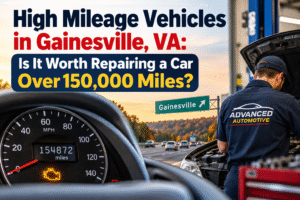
Driving a vehicle with more than 150,000 miles can make you nervous, especially when unexpected repairs start appearing. Imagine traveling along I-66 near Gainesville, Virginia, after a busy workday when your check engine light suddenly turns on. You look at the odometer and see 154,872 miles. Naturally, you begin wondering whether repairing your vehicle is still worth the investment.
Many drivers assume that once a vehicle crosses 150,000 miles, replacing it becomes the smartest option. However, mileage alone does not determine a vehicle’s reliability or remaining lifespan.
At Advanced Automotive in Gainesville, VA, we believe the decision to repair or replace a high-mileage vehicle should depend on its mechanical condition, maintenance history, repair costs, and long-term value.
With more than 35 years of automotive experience, Donnie, owner of Advanced Automotive, understands that a well-maintained vehicle with 200,000 miles can sometimes be more dependable than a neglected car with only 90,000 miles.
Understanding what makes a high-mileage vehicle worth repairing can help you avoid unnecessary expenses and make a confident decision.
Are Cars With Over 150,000 Miles Still Reliable?
Modern vehicles are engineered to last considerably longer than many older models. Improvements in engine technology, transmission design, synthetic lubricants, and manufacturing quality have increased vehicle durability.
Many vehicles manufactured by Toyota, Honda, Lexus, Ford, Chevrolet, Subaru, and Hyundai can exceed 200,000 miles when properly maintained.
However, reaching that mileage depends on several factors, including driving habits, maintenance schedules, road conditions, and previous repairs.
A vehicle that receives regular oil changes, cooling system maintenance, brake inspections, and transmission servicing may remain reliable for many additional years.
On the other hand, ignoring warning lights, fluid leaks, overheating, or unusual noises can significantly shorten a vehicle’s lifespan.
The most important consideration is not simply how far the vehicle has traveled, but how well it has been cared for throughout its life.
What Really Determines Whether a High-Mileage Vehicle Is Worth Repairing?
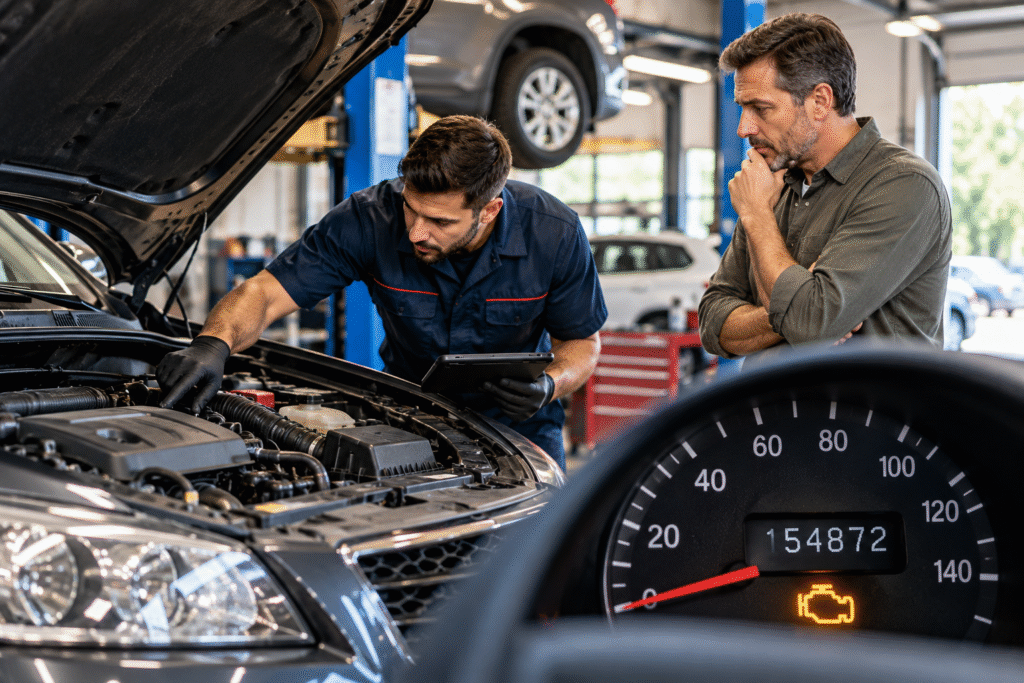
Before recommending expensive repairs, experienced automotive technicians should evaluate the vehicle’s overall mechanical condition.
At Advanced Automotive, assessing a high-mileage vehicle involves examining several essential systems.
Engine Condition: A healthy engine should operate smoothly without excessive oil consumption, serious internal damage, or persistent overheating.
Transmission Performance: Smooth gear changes and reliable transmission operation indicate that a vehicle may still have considerable useful life remaining.
Cooling System: Radiators, hoses, thermostats, and water pumps must function correctly to prevent engine overheating.
Suspension and Steering: Worn shocks, struts, bushings, and steering components can affect driving comfort and safety.
Brake System: Brake pads, rotors, calipers, and hydraulic components should be inspected to maintain reliable stopping performance.
Rust and Structural Integrity: Significant corrosion affecting the frame or critical structural components can make repairs financially impractical.
Maintenance History: Service records provide valuable information about previous repairs, recurring problems, and overall vehicle care.
A comprehensive inspection helps determine whether the vehicle has one manageable problem or several major mechanical issues developing simultaneously.
How Gainesville Driving Conditions Affect High-Mileage Cars
Driving conditions around Gainesville, Haymarket, and surrounding Northern Virginia communities can influence vehicle wear.
Daily commuting along I-66, Route 29, Route 28, and Linton Hall Road often involves heavy traffic, frequent braking, and extended periods of idling.
These conditions can increase wear on brakes, cooling systems, and certain transmission components.
Northern Virginia also experiences hot summers, freezing winter temperatures, and occasional road salt exposure.
Summer heat can accelerate battery deterioration, while winter temperatures may reveal weaknesses in aging batteries, hoses, and other components.
Although road salt contributes to corrosion, vehicles in this region may experience less prolonged exposure than those driven in areas with harsher winters.
Regular inspections and seasonal maintenance can help Gainesville drivers identify developing problems before they become expensive repairs.
Repair Costs vs. Vehicle Replacement Costs
One of the biggest mistakes drivers make is comparing a repair estimate only with their vehicle’s current market value.
Instead, it is important to consider the total cost of replacing the vehicle.
For example, imagine your high-mileage car needs new tires, front brakes, a water pump, and a battery.
The combined repair estimate is approximately $2,500.
Initially, spending that amount on an older vehicle may seem unreasonable.
However, purchasing another dependable used vehicle could require substantially more money, depending on its age, condition, and features.
Replacing your vehicle may also involve sales taxes, registration expenses, financing charges, insurance adjustments, and ongoing monthly payments.
If your current vehicle has a healthy engine, dependable transmission, and solid structure, completing the repairs may be significantly more affordable than replacing it.
Still, repairing a vehicle makes financial sense only when the expected remaining service life justifies the expense.
When Repairing a Car Over 150,000 Miles Makes Sense
Repairing a high-mileage vehicle can be a practical decision when its major mechanical systems remain in good condition.
Routine maintenance items such as brakes, tires, batteries, belts, hoses, and suspension components should not automatically be viewed as signs that a vehicle is finished.
These parts naturally wear out, regardless of mileage.
Even repairs costing several thousand dollars may be worthwhile when they restore dependable transportation and help avoid a much larger replacement expense.
Drivers should also consider whether the vehicle has been reliable over the previous several years.
A familiar, well-maintained vehicle with a documented service history may present fewer unknown risks than purchasing another used vehicle.
When Replacing Your High-Mileage Vehicle May Be Better
Although many older vehicles deserve repairs, some situations make replacement the more sensible option.
Major engine damage, serious transmission failure, extensive structural corrosion, or repeated expensive breakdowns may indicate that the vehicle is approaching the end of its economical service life.
Repairing multiple major systems within a short period can quickly become more expensive than anticipated.
Safety is another important consideration.
If a vehicle has severe structural deterioration or cannot be restored to safe operating condition at a reasonable cost, replacement deserves serious consideration.
The best decision involves comparing the repair estimate, vehicle value, anticipated future maintenance, and cost of alternative transportation.
Preventive Maintenance Helps High-Mileage Vehicles Last Longer
The best way to reduce expensive repairs is to maintain your vehicle consistently.
Regular oil changes using manufacturer-recommended products protect internal engine components.
Cooling system inspections help prevent overheating, while checking transmission fluid and following the appropriate service schedule can support long-term performance.
Drivers should also monitor tire condition, brake wear, battery health, suspension components, and fluid leaks.
Addressing minor mechanical problems early often prevents larger failures.
For vehicles exceeding 150,000 miles, periodic comprehensive inspections become particularly valuable.
A trusted automotive technician can identify deteriorating components and help prioritize repairs based on safety, reliability, and budget.
Trust Advanced Automotive for High-Mileage Car Repairs in Gainesville, VA
Owning a vehicle with more than 150,000 miles does not automatically mean it is time to buy another car.
A properly maintained vehicle may still offer years of reliable transportation, while an overlooked mechanical problem can make even a lower-mileage vehicle expensive to own.
At Advanced Automotive in Gainesville, VA, our goal is to help customers understand their vehicle’s condition and make informed repair decisions.
Whether you are dealing with a check engine light, engine performance issue, transmission concern, brake problem, or routine maintenance requirement, a professional inspection can help clarify your options.
We proudly serve drivers in Gainesville, Haymarket, and surrounding Northern Virginia communities.
Before giving up on your high-mileage vehicle, let Advanced Automotive evaluate its condition. The right repair today could help you enjoy many more dependable miles without the expense of replacing your car.
 Oil Change Gainesville

 Auto Brake Repair Gainesville, VA
 Towing Services Gainesville
 Fleet Services Gainesville
 Virginia Safety & Emissions Inspections
 Air Conditioning & Heating
 Wheel Alignment Warrenton
 Vehicle Diagnostic
 Auto Transmission Repair