

 Locations
 Hours
Hours Call Us Now
 Book Appointment


For many drivers in Gainesville, VA, an emissions test becomes a concern when registration renewal approaches. Questions often come up at the last minute: Does my vehicle need an emissions test? Will a check engine light cause a failure? Can I pass immediately after replacing my battery? What happens if my vehicle has not been driven recently?
These are common concerns, and understanding how Virginia emissions testing works can help you avoid unnecessary delays and unexpected repair costs.
At Advanced Automotive, we help drivers throughout Gainesville, Haymarket, Bristow, Manassas, Warrenton, and surrounding Northern Virginia communities with emissions diagnostics, vehicle maintenance, and repairs. With more than 35 years of automotive repair experience, we understand the issues that can prevent a vehicle from being ready for an emissions inspection.
The good news is that many emissions-related problems can be identified before inspection day. Knowing what the inspection checks and preparing your vehicle in advance can make the process much easier.
Virginia Emissions Testing in Gainesville: What’s Actually Happening?
Many drivers still think of emissions testing as a test that measures exhaust coming directly from the tailpipe. Modern vehicles, however, rely heavily on onboard diagnostic technology to monitor emissions-related systems.
Your vehicle’s onboard computer continuously monitors components and systems such as:
- Catalytic converter performance
- Oxygen sensor operation
- Fuel system efficiency
- Evaporative emissions systems
- Engine performance
- Emissions-related sensors
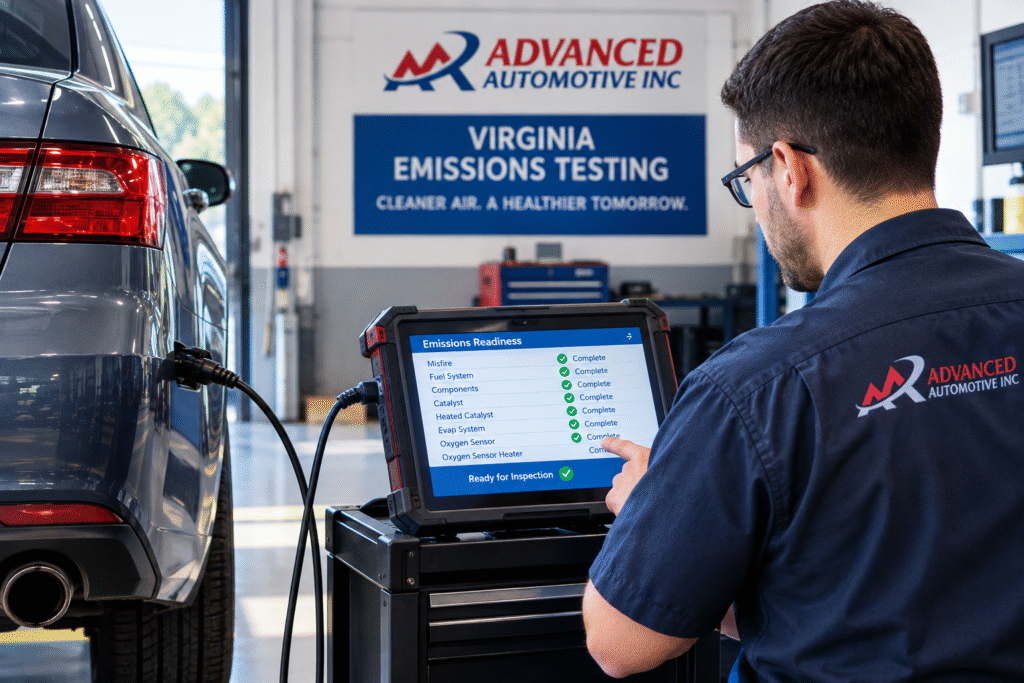
As you drive, the vehicle’s computer performs self-tests on these systems. These self-tests are commonly referred to as readiness monitors.
During an emissions inspection, testing equipment communicates with the vehicle’s onboard computer to determine whether the applicable monitors have completed their self-tests and whether emissions-related faults have been detected.
This means a vehicle can sometimes have an emissions inspection problem even when the check engine light is not illuminated.
Why Gainesville Drivers Run Into Emissions Problems More Often Than They Expect
Driving patterns can play a role in how quickly a vehicle completes its emissions-monitoring cycles.
Gainesville drivers regularly travel on Route 29, Route 55, Linton Hall Road, and I-66. Daily driving may involve stop-and-go traffic, short trips, frequent braking, and changing speeds. These conditions do not always provide the exact operating conditions required for every emissions monitor to complete its self-test.
One common situation occurs after a battery replacement.
When a vehicle’s battery is disconnected, certain diagnostic information can be cleared and emissions readiness monitors may reset. A driver may replace a battery and assume the vehicle is immediately ready for an emissions inspection because it starts and drives normally.
However, the onboard computer may still need additional driving time to complete its required self-tests.
Similar situations can occur after:
- Dead battery replacement
- Battery disconnection
- Check engine light repairs
- Diagnostic computer resets
- Certain electrical repairs
- Extended periods of vehicle storage
Drivers from Haymarket, Bristow, Nokesville, Manassas, and surrounding Northern Virginia communities can encounter the same issue.
In many cases, the solution is not replacing another component. The vehicle may simply need to complete the appropriate drive cycle so the required monitors can become ready.
Our Emissions Testing Process at Advanced Automotive
At Advanced Automotive, we focus on identifying potential issues before they become unexpected inspection-day problems.
Step 1: Verify Eligibility
We first determine whether the vehicle requires emissions testing based on applicable Virginia requirements.
Not every vehicle is subject to the same testing requirements, so confirming eligibility is an important first step.
Step 2: Scan for Diagnostic Trouble Codes
We check the vehicle’s onboard diagnostic system for relevant trouble codes.
Active or pending codes can provide valuable information about potential emissions-related or engine-performance problems.
Step 3: Verify Readiness Monitors
We check the status of the vehicle’s applicable emissions readiness monitors.
This is particularly important after a battery replacement, battery disconnection, or recent diagnostic repair.
Step 4: Perform the Official Emissions Inspection
Once the vehicle is ready, the required emissions inspection can be completed according to Virginia requirements.
Step 5: Explain the Results Clearly
If the vehicle passes, you’re ready to move forward.
If a problem is identified, we explain what caused the issue and what steps may be necessary to address it.
Our goal is accurate diagnosis not unnecessary parts replacement. If repairs are required, our ASE-certified technicians can diagnose and repair emissions-related vehicle problems.
Qualifying repairs are backed by our 12-month/12,000-mile warranty on parts and labor.
Warning Signs Your Vehicle May Fail an Emissions Test
Certain symptoms can indicate that your vehicle should be inspected before emissions-testing day.
Check Engine Light: An illuminated check engine light can indicate an emissions-related fault and may result in an inspection failure.
Recent Battery Replacement: A battery replacement can reset emissions readiness monitors, meaning the vehicle may need additional driving before inspection.
Battery Recently Disconnected: Disconnecting the battery can clear stored diagnostic information and reset certain emissions-monitoring systems.
Poor Fuel Economy: A noticeable change in fuel economy can sometimes point to an issue involving sensors, fuel delivery, or engine performance.
Rough Idle: An engine that idles roughly may have an underlying performance issue that can affect emissions.
Fuel Smell: A noticeable fuel smell around the vehicle may indicate a potential evaporative emissions system problem.
Previous Emissions Failure: If the vehicle has previously failed an emissions inspection, the underlying cause should be properly diagnosed before attempting another inspection.
What Does a Virginia Emissions Test Cost?
The emissions inspection fee is established by Virginia requirements. Additional costs may apply if your vehicle requires diagnostic work or repairs.
Repair costs depend on the specific issue and vehicle. Factors can include:
- Vehicle make and model
- Type of emissions failure
- Sensor replacement
- EVAP system repairs
- Catalytic converter problems
- Fuel-system issues
- Diagnostic complexity
Some problems may require a relatively simple repair, while others can require more extensive diagnosis.
At Advanced Automotive, we explain the issue and provide an estimate before beginning necessary repairs. This allows you to understand what needs to be repaired and what the expected cost will be.
Don’t Wait Until Registration Renewal Day
Waiting until the last possible day to address emissions testing can create unnecessary stress.
If your check engine light recently came on, your battery was replaced or disconnected, or your vehicle recently underwent diagnostic repairs, consider having it checked before your inspection deadline.
Addressing potential issues early gives you time to complete any necessary drive cycle and make repairs if required.
At Advanced Automotive, we have more than 35 years of experience helping drivers throughout Gainesville and surrounding Northern Virginia communities. Our team provides vehicle diagnostics, emissions-related repairs, and general automotive services for drivers in Gainesville, Haymarket, Bristow, Manassas, Warrenton, and nearby areas.
If you need help preparing for a Virginia emissions test in Gainesville, visit Advanced Automotive at 13380 University Blvd, Gainesville, VA, or call (703) 665-1818.
Our goal is simple: help you understand your vehicle, identify problems accurately, and address necessary repairs without unnecessary guesswork or surprises.
 Oil Change Gainesville
 Auto Brake Repair Gainesville, VA
  Towing Services Gainesville
  Fleet Services Gainesville
  Virginia Safety & Emissions Inspections
  Air Conditioning & Heating
  Wheel Alignment Warrenton
  Vehicle Diagnostic
  Auto Transmission Repair