

 Locations
 Hours
Hours Call Us Now
 Book Appointment



You’re accelerating onto I-66 from Route 29 during rush hour. You press the gas pedal, the engine revs higher, but your vehicle doesn’t accelerate the way it should. A few minutes later, everything feels normal again.
Most drivers ignore that moment.
A week later, it happens again. Then the symptoms become more frequent. Eventually, what may have started as a relatively minor transmission problem can turn into a major repair bill.
The important thing to understand is that transmission slipping does not always mean your transmission has failed. In many cases, early diagnosis can identify a repairable problem before serious internal damage occurs.
I’m Donnie, owner of Advanced Automotive in Gainesville. After more than 35 years of working on vehicles throughout Northern Virginia, I’ve seen how quickly a small transmission symptom can become an expensive problem when it’s ignored.
If your vehicle is slipping, hesitating, shifting roughly, or behaving differently when you accelerate, understanding the warning signs can help you make a better decision about your vehicle’s next step.
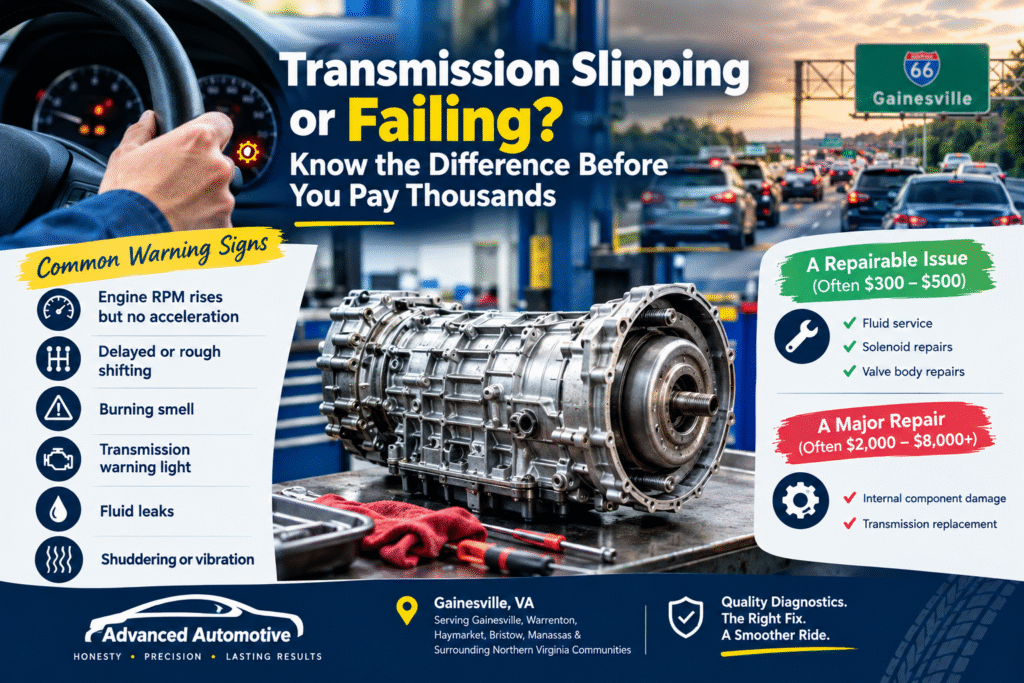
What Does Transmission Slipping Actually Mean?
Transmission slipping occurs when the transmission fails to transfer engine power to the wheels efficiently. One of the most noticeable signs is an increase in engine RPM without a corresponding increase in vehicle speed.
You may also notice:
- Delayed engagement when shifting into Drive or Reverse
- Hard or jerky gear changes
- Unexpected shifting between gears
- Hesitation during acceleration
- Loss of power while driving
- Engine RPM increasing without normal acceleration
- Shuddering or vibration during certain shifts
These symptoms can have several different causes.
Sometimes the problem is relatively straightforward, such as low transmission fluid, contaminated fluid, a faulty solenoid, an electronic control issue, or a valve body problem. Depending on the vehicle and the specific failure, these issues may be repairable without replacing the entire transmission.
That’s why assuming that every slipping transmission needs to be replaced can be an expensive mistake.
A transmission that is genuinely failing internally is a different situation. Worn clutch packs, damaged planetary gears, failing bearings, damaged bands, or torque converter problems can require much more extensive repairs.
The earlier the underlying problem is identified, the more repair options may be available.
Why Gainesville Driving Conditions Can Put Extra Stress on a Transmission
Northern Virginia driving can be demanding on automatic transmissions.
Drivers around Gainesville regularly deal with congestion, frequent stops, acceleration from traffic lights, and long commutes. Routes such as Route 29 and I-66 can involve extended periods of stop-and-go driving, which increases the amount of work a transmission performs.
Heat is particularly important.
Automatic transmission fluid does more than lubricate internal components. It also helps transfer heat away from the transmission. As temperatures increase, fluid can deteriorate, reducing its ability to protect internal components and maintain proper hydraulic operation.
Repeated exposure to high temperatures, combined with heavy traffic and vehicle age, can contribute to transmission wear.
Drivers commuting between Gainesville, Haymarket, Bristow, and Manassas may spend significant amounts of time in traffic without realizing how much additional stress their vehicles experience.
This is one reason regular maintenance and early diagnosis matter.
Why Proper Transmission Diagnosis Comes First
One of the biggest mistakes a vehicle owner can make is agreeing to a transmission replacement before the actual cause of the problem has been identified.
At Advanced Automotive, the process starts with diagnosis rather than immediately recommending a major repair.
The first step is computer diagnostics. Modern transmissions rely heavily on electronic controls, sensors, solenoids, and transmission control modules. Diagnostic equipment can help identify stored fault codes and abnormal operating data.
Next comes a transmission fluid inspection. Fluid condition can provide valuable information about what’s happening inside the system. Technicians may look for unusual color, burnt odor, contamination, incorrect fluid level, or metal debris.
A road test can then help reproduce the problem under real driving conditions. Some transmission issues only appear when the vehicle is cold, under acceleration, at highway speeds, or after the transmission reaches operating temperature.
If necessary, additional component evaluation may include the transmission solenoids, valve body, transmission mounts, torque converter operation, and cooling system.
This step-by-step approach helps separate a repairable problem from a transmission that has experienced significant internal damage.
You can learn more about the types of vehicle repairs we handle by visiting the Advanced Automotive services page.
Warning Signs You Shouldn’t Ignore
Transmission problems rarely appear without warning.
If your vehicle is experiencing any of the following symptoms, it’s worth having it inspected before the condition becomes worse:
RPMs rise but the vehicle doesn’t accelerate normally This is one of the classic signs of transmission slipping.
The vehicle hesitates before moving: Delayed engagement can be associated with fluid, pressure, electronic, or internal transmission problems.
Hard or jerky shifting: Rough gear changes can indicate mechanical wear or an issue with electronic transmission controls.
Burning smell: An overheated or deteriorated transmission fluid can produce a noticeable burnt odor.
Transmission warning light: Modern vehicles can detect abnormal transmission operation and store diagnostic trouble codes.
The vehicle drops out of gear: Unexpected loss of engagement can indicate a potentially serious transmission problem.
Transmission fluid leaking: Low fluid levels can create additional heat and accelerate internal wear.
Shuddering during acceleration: This can sometimes be associated with torque converter or clutch engagement problems.
Ignoring these symptoms doesn’t make them disappear. In some cases, continued driving allows friction material and debris from damaged components to circulate through the transmission, potentially affecting parts that were originally still serviceable.
How Much Does Transmission Repair Cost in Gainesville, VA?
Transmission repair costs can vary significantly because there is no single repair that fits every vehicle.
As a general range, drivers may encounter costs such as:
- Fluid service and minor repairs: Approximately $200–$500
- Solenoid repairs: Approximately $300–$900
- Valve body repairs: Approximately $600–$1,500
- Major internal repairs: Approximately $2,000–$4,500+
- Complete transmission replacement: Often $4,000–$8,000+
These are general estimates, not guaranteed prices. The actual cost depends on the vehicle’s make and model, transmission design, parts availability, labor requirements, and the extent of damage.
A transmission problem on a Honda, Ford, Toyota, BMW, or Ram can have completely different diagnostic and repair requirements.
That’s why getting an accurate diagnosis before authorizing major work is so important.
The Difference Between a Repair and a Replacement
The key question isn’t simply, “Is my transmission slipping?”
The more important question is why is it slipping?
If the problem is caused by fluid condition, a solenoid, an electronic control issue, or another serviceable component, a targeted repair may solve the problem.
If internal components are severely worn or damaged, rebuilding or replacing the transmission may become necessary.
There is no responsible way to determine that from one symptom alone.
A proper inspection gives you information about the condition of the transmission before you spend thousands of dollars.
At Advanced Automotive, repairs are backed by a 12-month/12,000-mile warranty on parts and labor. Free towing with repair and free local pickup and delivery are also available throughout the Gainesville and Warrenton areas.
For drivers who live or work in the Warrenton area, the Advanced Automotive Warrenton location provides another convenient option for vehicle service.
Don’t Let a Small Transmission Problem Become a Major Repair
I’ve seen customers arrive at our Gainesville shop convinced they need a complete transmission replacement because their vehicle started slipping.
Sometimes a major repair really is necessary.
But not every slipping transmission is finished.
The difference can come down to diagnosis and timing.
If your vehicle is slipping, hesitating, shifting hard, shuddering, or showing any unusual transmission behavior, don’t wait until it stops moving completely. Having the vehicle inspected while the problem is still developing may give you more repair options and potentially prevent additional damage.
At Advanced Automotive, we believe customers deserve a clear explanation of what’s happening before making a major repair decision.
If you’re experiencing transmission problems in Gainesville, VA, call (703) 665-1818 or visit 13380 University Blvd, Gainesville, VA. We also serve drivers throughout Warrenton, Haymarket, Bristow, Manassas, and surrounding Northern Virginia communities.
Before spending thousands on a transmission replacement, get the problem properly diagnosed. A smaller repair today could prevent a much larger transmission bill tomorrow.
 Oil Change Gainesville
 Auto Brake Repair Gainesville, VA
  Towing Services Gainesville
  Fleet Services Gainesville
  Virginia Safety & Emissions Inspections
  Air Conditioning & Heating
  Wheel Alignment Warrenton
  Vehicle Diagnostic
  Auto Transmission Repair