

 Locations
 Hours
Hours Call Us Now
 Book Appointment


You’re driving down Route 29 near Warrenton on your way home from work when suddenly that little orange engine-shaped light appears on your dashboard.
Your first thought may be, How much is this going to cost? Your next question is usually, Can I keep driving?
After more than 35 years of automotive repair experience in Northern Virginia, the team at Advanced Automotive has seen how much confusion a check engine light can create. The warning light itself does not tell you exactly what has gone wrong. It could be something as simple as a loose gas cap, or it could indicate a problem that requires immediate attention.
The important thing is understanding what the warning means and getting the vehicle properly diagnosed before replacing parts unnecessarily.
What Is the Check Engine Light Actually Telling You?
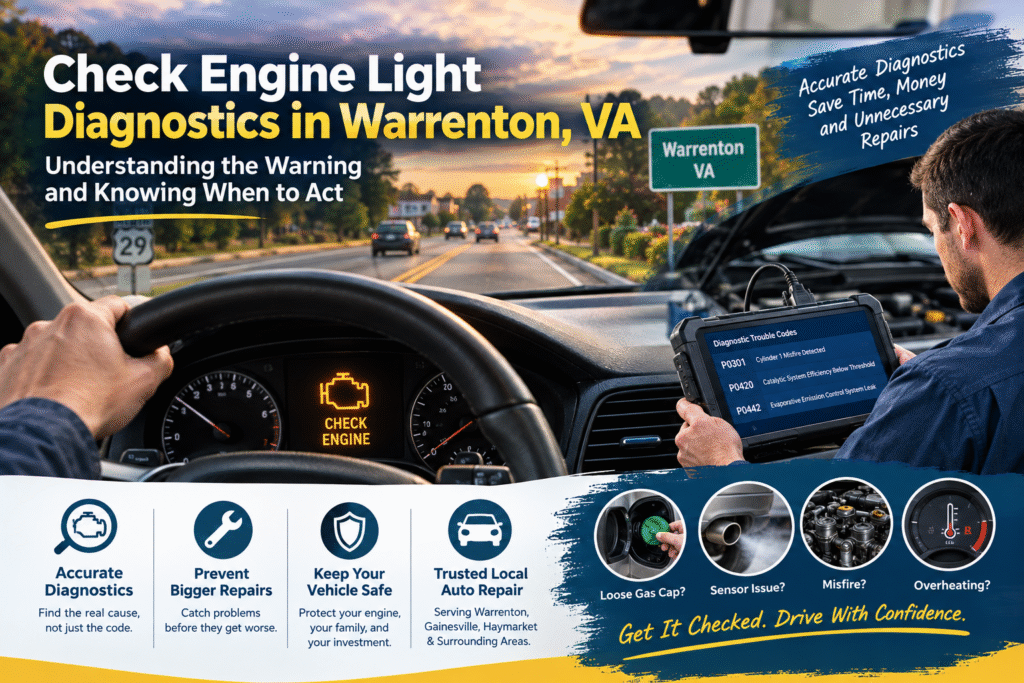
The check engine light is not a specific part that has failed. Instead, it is a warning from your vehicle’s onboard computer that something may not be operating within its expected range.
Modern vehicles use numerous sensors and computer-controlled systems to monitor engine performance, emissions, fuel delivery, ignition, and other functions. When the computer detects an abnormal reading, it can store a Diagnostic Trouble Code (DTC) and turn on the check engine light.
One common mistake drivers make is assuming that the diagnostic code automatically identifies the part that needs to be replaced.
It doesn’t.
A trouble code points a technician toward a particular system or condition. Proper diagnostic testing is needed to determine the actual cause.
For example, an oxygen-sensor-related code does not necessarily mean the oxygen sensor itself has failed. The underlying issue could involve a vacuum leak, exhaust leak, fuel-delivery problem, wiring issue, or the sensor itself.
That is why replacing parts simply because a code appears can lead to unnecessary expenses.
Why Check Engine Lights Are Common in Warrenton
Warrenton drivers experience a variety of driving conditions that can affect vehicle systems over time.
Vehicles may travel on faster roads such as Route 29, Route 15, and Lee Highway before transitioning into stop-and-go traffic around shopping areas and residential developments. Frequent changes in driving conditions can place additional demands on different vehicle systems.
Seasonal conditions can also contribute to certain warning lights.
During colder months, short trips may prevent an engine from reaching its normal operating temperature. This can contribute to certain emissions-related problems. Temperature changes can also expose weaknesses in batteries and other electrical components.
Drivers traveling through surrounding areas such as Haymarket, Bealeton, and other Fauquier County roads may also encounter construction zones and dusty conditions that can contribute to sensor contamination.
Another common situation occurs after refueling. If a check engine light appears shortly after visiting a gas station, an EVAP-related issue may be involved. In some cases, the cause can be a loose, damaged, or improperly sealed gas cap.
However, proper testing is still necessary to determine the actual cause.
Which Check Engine Codes Require Immediate Attention?
Not every check engine light means you need to stop driving immediately. The condition of the vehicle and the way the warning light behaves are important.
Engine Misfire Codes: P0300-P0308
Misfire codes are among the warning codes that deserve prompt attention.
A significant engine misfire can affect engine performance and may damage the catalytic converter if the vehicle continues operating under certain conditions.
If the check engine light is flashing, stop driving when it is safe to do so and have the vehicle inspected as soon as possible.
Oil Pressure Warnings
If an engine warning is accompanied by an oil-pressure warning, safely pull over and shut the engine off.
Continuing to operate an engine without adequate oil pressure can result in serious engine damage.
Overheating Problems
Overheating should also be treated as an urgent concern. Continued driving when an engine is overheating can cause significant damage.
Check Engine Codes That May Allow Limited Driving
Some check engine light conditions are less likely to require an immediate stop, particularly when the vehicle is operating normally.
P0440-P0457 EVAP Codes
These codes are commonly associated with the evaporative-emissions system. A loose gas cap or another vapor-system leak may be involved.
Although these issues may not always create an immediate drivability problem, they should still be diagnosed and repaired.
P0420 Catalytic Efficiency Code
A P0420 code generally does not mean the vehicle must immediately be taken off the road. However, the underlying cause should be diagnosed rather than simply replacing the catalytic converter based on the code alone.
Oxygen Sensor Codes
Oxygen-sensor-related codes may sometimes allow short-term driving when the vehicle otherwise operates normally. However, they can affect fuel economy and emissions performance, making timely diagnosis important.
The Flashing Check Engine Light Rule
One of the most important things drivers should know is the difference between a steady and flashing check engine light.
A steady light does not automatically mean there is an emergency.
A flashing check engine light, particularly when accompanied by shaking, rough running, loss of power, or other drivability problems, can indicate an active misfire or another condition that may cause additional damage.
If the light is flashing, avoid continuing to drive unnecessarily and have the vehicle inspected promptly.
Why a Code Reader Isn’t the Same as a Diagnosis
A basic code reader can tell you that a diagnostic trouble code has been stored.
But knowing the code is only the beginning.
At Advanced Automotive, the diagnostic process can include retrieving stored and pending trouble codes, reviewing freeze-frame data, performing system-specific tests, checking applicable technical service information, and verifying the repair before clearing the codes.
Live data may also be reviewed while the vehicle is operating.
This helps technicians distinguish between the symptom identified by the computer and the actual cause of the problem.
For example, a vehicle may arrive after another repair shop recommends replacing an expensive component. Further testing can sometimes reveal a damaged wire, loose connector, vacuum leak, or another issue causing the original fault.
Proper diagnostics help reduce guesswork and unnecessary parts replacement.
Warning Signs That Your Check Engine Light May Be More Serious
Pay attention to how your vehicle behaves when the warning light appears.
Important warning signs can include:
- Flashing check engine light
- Rough or unstable idle
- Engine shaking during acceleration
- Significant loss of power
- Strong fuel smell
- Sudden decrease in fuel economy
- Difficulty starting
- Engine overheating
A steady check engine light with no noticeable change in vehicle operation may not require an immediate stop.
However, a flashing light combined with drivability problems deserves prompt attention.
What Does Check Engine Light Diagnosis Cost in Warrenton?
Diagnostic costs vary depending on the vehicle, the complexity of the problem, and the amount of testing required.
The original draft estimates that professional diagnostic testing in the Warrenton area typically ranges from approximately $100 to $200, although actual pricing can vary.
The repair cost can be much different because the check engine light itself is not the repair.
The underlying issue could be something relatively simple, such as a gas cap or vacuum hose, or it could involve a sensor, emissions system, ignition system, fuel system, or engine component.
Vehicle make, model, mileage, and the specific fault all affect the final repair cost.
Getting an accurate diagnosis before approving repairs can help you understand exactly what your vehicle needs.
Advanced Automotive provides an estimate before repairs begin and backs qualifying repairs with a 12-month/12,000-mile warranty on parts and labor. The shop also offers free towing with qualifying repairs and free local pickup and delivery in many cases throughout the Warrenton and Gainesville areas.
Get Your Check Engine Light Properly Diagnosed
The biggest mistake drivers can make is ignoring a check engine light for months simply because the vehicle still appears to drive normally.
Another common mistake is replacing parts before the vehicle has been properly tested.
Neither approach provides a reliable answer.
If your check engine light has appeared in Warrenton, Gainesville, Haymarket, Bristow, Manassas, or a surrounding Northern Virginia community, start with an accurate diagnosis.
Once you know what is actually causing the warning light, you can make an informed decision about the necessary repair.
Advanced Automotive serves drivers throughout the Northern Virginia area and provides professional vehicle diagnostics and repair services.
Call (703) 665-1818 or visit 13380 University Blvd, Gainesville, VA to have your vehicle checked.
No guessing. No unnecessary parts replacement. Just a clear explanation of what is happening with your vehicle and what needs to be done next.
 Oil Change Gainesville
 Auto Brake Repair Gainesville, VA
  Towing Services Gainesville
  Fleet Services Gainesville
  Virginia Safety & Emissions Inspections
  Air Conditioning & Heating
  Wheel Alignment Warrenton
  Vehicle Diagnostic
  Auto Transmission Repair