

 Locations
 Hours
Hours Call Us Now
 Book Appointment


You’re heading home on I-66 after a long day at work. Traffic finally starts moving, and then you hear it—a harsh grinding sound every time you press the brake pedal. Your first concern probably isn’t what caused the noise. It’s how much it is going to cost to fix it.
For many drivers, brake repair can feel unpredictable. One vehicle may need a relatively simple brake pad replacement, while another may require new pads, rotors, calipers, or additional brake system repairs. Without knowing what is actually wrong, it can be difficult to understand whether an estimate is reasonable.
At Advanced Automotive, we’ve been helping drivers throughout Gainesville and Northern Virginia for more than 35 years. Over that time, we’ve learned that customers are rarely frustrated by necessary repairs. What frustrates them is uncertainty about what their vehicle needs and how much the repair should cost.
That’s why we’re breaking down the brake repair cost in Gainesville, VA, in 2026, including realistic price ranges for common brake services and the factors that can make one repair significantly more expensive than another.
Understanding What “Brake Repair” Really Means
Brake repair is not one specific service. The work required depends on the condition of the entire braking system and the cause of the problem.
In some cases, the brake pads are simply worn and need to be replaced. In others, worn pads may have damaged the rotors, requiring both components to be replaced. A sticking caliper can create excessive heat and uneven wear, while contaminated brake fluid or a damaged brake hose can create hydraulic problems that affect braking performance.
This is why two drivers can bring in similar-looking vehicles with completely different repair estimates.
A proper brake inspection should identify the source of the problem before parts are recommended. Replacing components that are still in good condition doesn’t make sense, but continuing to drive with a damaged or unsafe braking system can lead to more expensive repairs later.
Why Gainesville Drivers May Experience Faster Brake Wear
Driving conditions have a major effect on how quickly brake components wear.
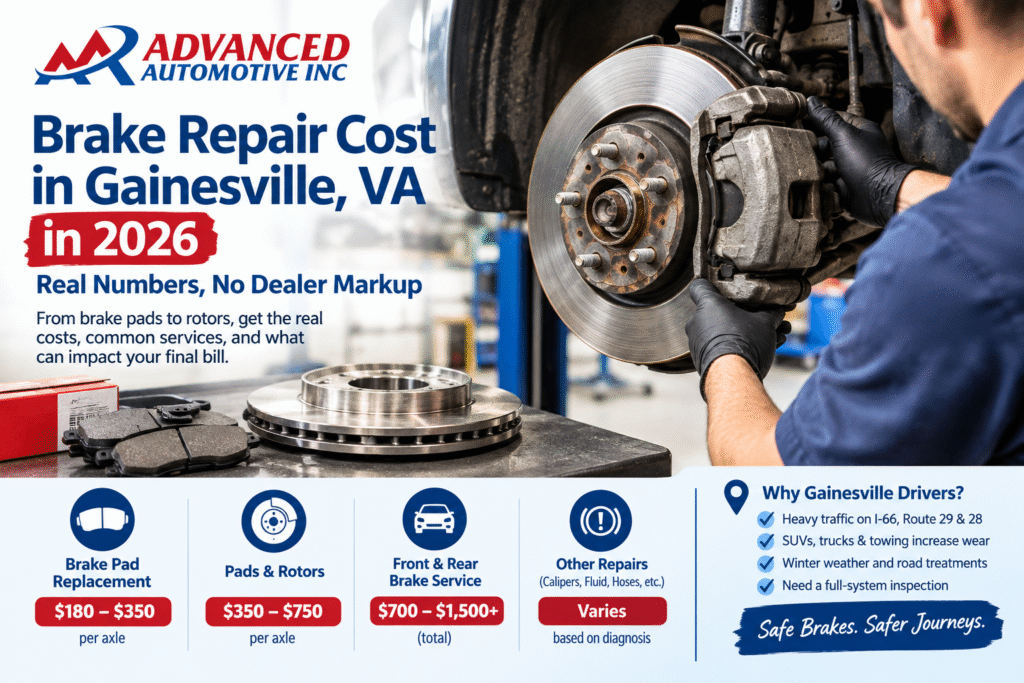
Drivers traveling through Gainesville, Haymarket, Bristow, Nokesville, Manassas, and surrounding communities often deal with significant traffic on I-66, Route 29, and Route 28. Stop-and-go traffic requires frequent acceleration and braking, which creates additional heat and friction within the braking system.
Vehicle use matters as well. Larger SUVs and trucks generally place more demand on their brakes than smaller passenger cars. Drivers who regularly tow campers, trailers, landscaping equipment, or other heavy loads may also experience increased brake wear.
Northern Virginia weather can contribute to brake component deterioration too. Winter road treatments and moisture can accelerate corrosion on exposed brake components, particularly rotors. A vehicle can sometimes have plenty of brake pad material remaining while its rotors have developed significant rust or surface damage.
For that reason, brake condition should be evaluated based on the complete system rather than pad thickness alone.
Real Brake Repair Costs in Gainesville, VA in 2026
Brake repair prices vary depending on the vehicle, parts required, labor, and overall condition of the braking system. However, having realistic price ranges can help Gainesville drivers understand what they may encounter when their vehicle needs service.
Brake Pad Replacement
For many common vehicles, brake pad replacement typically falls in the range of $180 to $350 per axle.
The actual cost depends on the vehicle’s make and model, the type of brake pads being installed, and the labor involved. Ceramic and semi-metallic pads can have different pricing and performance characteristics, while luxury, performance, and imported vehicles may require more specialized components.
Brake pads are designed to wear over time. Replacing them before they are completely worn out can help prevent the backing plate from damaging the rotor.
Brake Pads and Rotors
When both the pads and rotors require replacement, Gainesville drivers can generally expect to pay approximately $350 to $750 per axle for many vehicles.
This is one of the most common brake repairs because rotors can become worn, damaged, excessively corroded, or fall below the manufacturer’s minimum thickness.
Replacing the pads without addressing severely damaged rotors can result in poor braking performance, noise, vibration, or premature pad wear. A professional inspection determines whether the existing rotors can safely remain in service or need to be replaced.
Complete Front and Rear Brake Service
If both the front and rear brakes require service, the total repair cost can typically range from $700 to $1,500 or more.
The size and type of vehicle make a significant difference. A compact sedan may require considerably less in parts and labor than a full-size SUV or heavy-duty truck.
Rather than assuming that every vehicle needs all four brakes replaced, a good repair shop should inspect each axle separately and explain what actually needs attention.
Brake Caliper Replacement
A damaged or sticking brake caliper can cost approximately $250 to $800 per caliper, depending on the vehicle and the parts required.
Calipers play an essential role in applying pressure to the brake pads. If one sticks or fails to release properly, it can cause uneven brake wear, overheating, pulling while braking, and additional damage to the rotor and pads.
Addressing a caliper problem early can help prevent these secondary issues.
Brake Fluid Service
Brake fluid service generally costs around $120 to $220, depending on the vehicle and service requirements.
Brake fluid can absorb moisture over time, which may affect the performance of the hydraulic braking system. Following the vehicle manufacturer’s maintenance recommendations can help keep the braking system operating properly.
What a Professional Brake Inspection Should Look For
A brake inspection should involve much more than checking how much brake pad material is left.
At Advanced Automotive, technicians evaluate the condition and operation of the major components that affect braking performance. This includes the brake pads, rotors, calipers, brake hoses, hardware, and brake fluid. We also look for signs of uneven wear, rotor runout, ABS warning indicators, wheel bearing concerns, and related tire wear.
The objective is simple: identify the actual problem before recommending a repair.
We’ve seen vehicles arrive after owners were told they urgently needed brakes, only to find that certain components still had useful service life remaining. On the other hand, we’ve also seen vehicles with apparently acceptable pad thickness that had serious rotor, caliper, or other brake-system problems.
An accurate inspection provides the information needed to make the right decision.
Don’t Ignore the Warning Signs
Brake problems rarely appear without warning. Squealing may indicate worn pads or a wear indicator contacting the rotor. Grinding can mean the friction material has been completely worn away, allowing metal components to contact the rotor.
A vibrating steering wheel during braking may indicate a rotor or braking-system issue. A soft or spongy pedal can point to a hydraulic problem, while a vehicle pulling to one side may be experiencing uneven braking or a sticking caliper.
A burning smell after driving can also indicate an overheating brake component. If the brake warning light comes on or you notice that your vehicle requires more distance to stop, the braking system should be inspected as soon as possible.
Continuing to drive with a known brake problem can turn a relatively simple repair into a much more expensive one.
Getting the Repair You Actually Need
One of the biggest concerns drivers have when visiting a repair facility is whether they are being told to replace more parts than necessary.
At Advanced Automotive, our approach is based on inspection and explanation. We want customers to understand what is wrong with their vehicle, why a repair is recommended, and what the expected cost will be before work begins.
An independent automotive repair shop may also be able to provide repair options based on the actual condition of the vehicle rather than automatically replacing complete assemblies. The goal isn’t to use the cheapest possible parts or cut corners. The goal is to perform the appropriate repair using quality components and proper procedures.
For Gainesville drivers, that can mean avoiding unnecessary expenses while still maintaining a safe and reliable braking system.
Why Gainesville Drivers Trust Advanced Automotive
For more than 35 years, Advanced Automotive has served drivers throughout Gainesville and surrounding Northern Virginia communities. Our ASE-certified technicians focus on accurate diagnosis, honest recommendations, and quality automotive service.
We provide transparent estimates before repairs begin and take the time to explain our findings. Qualifying repairs may also include benefits such as free towing, local pickup and delivery, and a 12-month/12,000-mile warranty on parts and labor.
Most importantly, we believe customers should never feel pressured into a repair they don’t understand.
Get a Straight Answer About Your Brakes
Brake repair doesn’t have to be a guessing game.
If you’re hearing grinding, experiencing vibration, noticing uneven braking, or simply want to know how much life remains in your brake system, having the vehicle professionally inspected can give you a clear picture of what needs attention.
At Advanced Automotive, we’ll explain what we find and provide an estimate before any repair work begins.
Call (703) 665-1818 or visit Advanced Automotive at 13380 University Blvd, Gainesville, VA. We also serve drivers from Warrenton, Haymarket, Bristow, Manassas, Centreville, and surrounding Northern Virginia communities.
When it comes to something as important as your brakes, you deserve more than a number on an estimate. You deserve to understand what you’re paying for and why.
 Oil Change Gainesville
 Auto Brake Repair Gainesville, VA
  Towing Services Gainesville
  Fleet Services Gainesville
  Virginia Safety & Emissions Inspections
  Air Conditioning & Heating
  Wheel Alignment Warrenton
  Vehicle Diagnostic
  Auto Transmission Repair