

 Locations
 Hours
Hours Call Us Now
 Book Appointment


A Virginia State Inspection is an important part of maintaining a safe and legally compliant vehicle. Yet for many drivers, an inspection only becomes a concern when a vehicle fails and an unexpected repair is suddenly required.
A vehicle can run smoothly, handle well, and appear perfectly normal while still having a safety-related issue that prevents it from passing inspection. In many cases, the problem may be something as simple as a burned-out light bulb, worn windshield wipers, or inadequate tire tread. Other failures may involve brakes, steering, suspension, or other components that require more extensive attention.
For drivers in Gainesville and surrounding Northern Virginia communities, understanding what is checked during a Virginia State Inspection and identifying potential problems before inspection day—can make the process considerably easier.
At Advanced Automotive in Gainesville, we have been helping Northern Virginia drivers with vehicle maintenance, repairs, and inspections for more than 35 years. Our approach is straightforward: identify the problem, explain why it matters, and help the customer make an informed decision about the next step.
What Is a Virginia State Inspection?
A Virginia State Inspection is designed to evaluate important safety equipment and vehicle components according to Virginia’s inspection requirements. The inspection is not simply a test of whether a vehicle starts, runs, or drives properly.
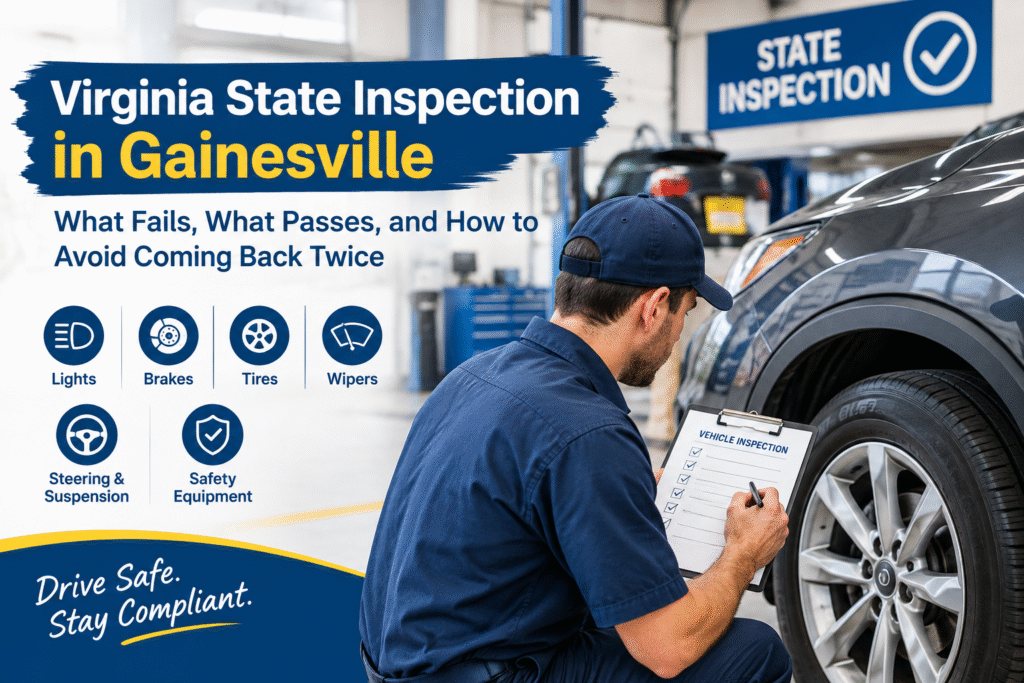
Inspectors examine various components that contribute to safe operation on the road. Depending on the vehicle, these may include lighting equipment, brakes, tires, windshield condition, wipers, steering and suspension components, the horn, and other required safety equipment.
This distinction is important because some vehicle problems cannot be detected through normal driving.
A driver may not notice that a brake component is approaching the end of its service life or that a tire has developed excessive wear. An inspection provides an opportunity to identify these concerns before they become more serious safety problems.
Common Reasons Vehicles Fail Virginia State Inspection
Inspection failures can occur for a wide range of reasons, but several issues appear regularly.
Lighting problems are among the simplest issues to overlook. A headlight, brake light, or turn signal may stop working without affecting the way the vehicle drives. Because these lights are essential for visibility and communication with other drivers, they can become an inspection concern.
Brake condition is another major consideration. Worn brake pads, damaged rotors, or other brake-system problems may result in a failed inspection. Drivers sometimes wait until they hear significant noise or feel a noticeable change in braking performance, but brake components can wear substantially before obvious symptoms appear.
Tires are also closely associated with vehicle safety. Insufficient tread, visible damage, cracking, or abnormal wear can indicate that a tire requires replacement or further evaluation.
Windshield condition and wiper performance are equally important. Damage in areas that affect visibility can become an inspection issue, while worn wiper blades can make it difficult to maintain a clear view during rain.
Steering and suspension components can also develop wear over time. Problems involving these systems may not always produce an immediate warning to the driver, particularly when the wear develops gradually.
The important takeaway is that an inspection failure does not necessarily mean there is a major mechanical problem. Sometimes a relatively inexpensive repair is enough to bring the vehicle into compliance.
Why Local Driving Conditions Matter in Gainesville
Vehicles in Gainesville experience a combination of commuting, highway driving, traffic congestion, and changing road conditions.
Route 29 and I-66 are important travel routes for local commuters, while continued development around University Boulevard and surrounding areas means drivers regularly encounter construction activity and changing road surfaces.
Frequent stop-and-go traffic can contribute to brake wear. Rough or uneven roads can place additional stress on suspension components. Long-distance commuting can increase annual mileage and accelerate tire wear.
Highway travel can also increase exposure to road debris, which may result in windshield or tire damage.
These factors do not automatically mean a vehicle will fail inspection. However, they demonstrate why regular maintenance is important for drivers who depend on their vehicles every day.
A vehicle that feels normal during a daily commute can still have a component that requires attention.
Warning Signs That Should Not Be Ignored
Your vehicle may provide early indications that something needs to be checked before inspection day.
Brake squealing or grinding should be evaluated rather than ignored. Similarly, a vehicle that pulls to one side may have an issue involving tires, alignment, steering, or suspension.
Vibration at highway speeds can indicate a problem with the tires, wheels, or alignment. Uneven tire wear can also provide an early indication of alignment or suspension concerns.
Drivers should also pay attention to lighting performance. Dim, flickering, or non-functioning lights should be addressed before an inspection.
Windshield wipers that leave streaks or fail to clear water effectively can reduce visibility and should be replaced when necessary. Excessive bouncing after driving over bumps may indicate worn shocks or struts.
Visible tire cracking or damage should receive immediate attention, even if the vehicle otherwise drives normally.
Addressing these warning signs early can help prevent minor issues from becoming more expensive repairs.
Preparing Your Vehicle Before the Inspection
One of the most effective ways to reduce the likelihood of an unexpected inspection failure is to have the vehicle checked before the official inspection.
Drivers can begin with several basic observations. Check that headlights, brake lights, and turn signals are functioning. Examine the tires for visible damage and unusual wear. Inspect the windshield and evaluate whether the wipers are clearing water properly.
It is also worth paying attention to how the vehicle behaves while driving. Unusual braking sounds, steering changes, vibrations, or excessive bouncing can all indicate that a professional inspection may be worthwhile.
A pre-inspection check is particularly useful when the inspection deadline is approaching. Identifying a problem early provides more time to evaluate repair options rather than discovering the issue when the vehicle is already at the inspection station.
How Advanced Automotive Approaches Vehicle Inspections
At Advanced Automotive, the objective is not simply to determine whether a vehicle passes or fails.
Clear communication is an important part of the process.
When an inspection identifies a problem, customers should understand what failed, why it failed, whether it represents a safety concern, and what options are available to address it.
That is the approach we take with every vehicle.
Whenever possible, our technicians explain and demonstrate the issue so customers can make decisions based on information rather than uncertainty. Repair estimates are provided before additional work is performed, helping customers understand the expected cost.
If a vehicle passes inspection, that is the outcome everyone wants. If it does not pass, the goal is to clearly identify the reason and determine the most appropriate solution.
We may also identify components that are not currently an inspection failure but are showing signs of wear. Knowing about these issues in advance can help vehicle owners plan future maintenance and avoid unexpected problems.
Qualifying repairs are backed by a 12-month/12,000-mile warranty on parts and labor. For major repairs, free towing with repair and free local pickup and delivery may also be available.
Understanding the Cost of a Virginia State Inspection
The inspection fee itself is regulated by Virginia. However, the total amount a vehicle owner spends may depend on whether repairs are necessary after the inspection.
Repair costs vary according to the vehicle’s make and model, parts availability, the severity of the issue, and the number of components requiring attention.
A lighting problem may require only a simple repair, while worn brakes, damaged tires, or suspension components can involve a larger investment.
Additional diagnostic work may also be recommended when an issue requires further evaluation.
At Advanced Automotive, we believe customers should understand what their vehicle needs before approving additional repairs. Providing a clear explanation and estimate helps eliminate surprises and allows vehicle owners to make informed decisions.
Make Your Next Inspection Easier
A Virginia State Inspection should not be something you prepare for only after receiving a rejection sticker.
Regular maintenance and a simple pre-inspection check can identify many common problems before they interfere with your inspection.
For Gainesville drivers, this is particularly valuable when the vehicle is used regularly for commuting on I-66, Route 29, and surrounding Northern Virginia roads.
The goal is not simply to pass an inspection. The goal is to make sure the vehicle’s essential safety systems are working properly and that potential problems are identified before they become more serious.
At Advanced Automotive, we have spent more than 35 years serving drivers throughout Gainesville and surrounding communities, including Haymarket, Warrenton, Bristow, and Manassas.
If your Virginia State Inspection is approaching, visit Advanced Automotive at 13380 University Blvd, Gainesville, VA, or call (703) 665-1818.
Our team will help you understand your vehicle’s condition, identify inspection-related concerns, and determine the appropriate next step—without unnecessary confusion or pressure.
 Oil Change Gainesville
 Auto Brake Repair Gainesville, VA
  Towing Services Gainesville
  Fleet Services Gainesville
  Virginia Safety & Emissions Inspections
  Air Conditioning & Heating
  Wheel Alignment Warrenton
  Vehicle Diagnostic
  Auto Transmission Repair