

 Locations
 Hours
Hours Call Us Now
 Book Appointment


Gainesville, Virginia, has experienced significant growth in recent years. New homes, shopping centers, warehouses, and construction projects have brought more people and more vehicles onto local roads. For drivers, that growth has also meant longer commutes, heavier traffic, and more frequent stop-and-go driving.
If you regularly travel on I-66, Route 29, Route 55, Linton Hall Road, or Route 15, your vehicle may be spending much more time creeping through traffic than it did a few years ago.
That matters because constant stop-and-go driving can place additional stress on your transmission.
At Advanced Automotive in Gainesville, we see drivers who are surprised when their vehicle begins shifting roughly, hesitating, slipping, or struggling to accelerate even when the vehicle does not have extremely high mileage. In many cases, the problem isn’t simply mileage. Driving conditions, heat, maintenance, and repeated shifting can all contribute to transmission wear.
Why Stop-and-Go Traffic Is Hard on Your Transmission
Many drivers assume that highway mileage is the biggest factor affecting transmission life. While mileage certainly matters, the type of driving you do can be just as important.
During normal highway driving, your vehicle can maintain a relatively consistent speed and spend extended periods in higher gears. In heavy traffic, however, the transmission may constantly shift between lower gears.
Think about a typical commute through a construction zone. You move forward a few feet, stop, move again, and stop again. This process may continue for 20 or 30 minutes.
Every acceleration and deceleration requires your vehicle’s transmission to manage changing gears and vehicle speeds. Over time, repeated stop-and-go driving can contribute to additional heat and wear.
Heat is particularly important because transmission fluid plays a critical role in lubrication and temperature control. When transmission fluid becomes excessively hot or deteriorates, it may not protect internal components as effectively as it should.
That can contribute to premature wear and transmission problems.
Why Gainesville Traffic Can Increase Transmission Stress
Gainesville’s ongoing development has changed daily driving conditions for many local residents.
Rush-hour traffic on roads such as I-66, Route 29, Route 55, Linton Hall Road, and Route 15 can involve frequent braking, acceleration, and shifting.
Drivers traveling between Gainesville, Haymarket, Bristow, Manassas, Centreville, and surrounding communities may experience these conditions regularly.
Construction zones can make the situation even more demanding. Traffic may slow unexpectedly, lanes can merge, and vehicles may spend extended periods idling or crawling forward.
During the summer months, high outdoor temperatures can add another challenge. When hot weather combines with heavy traffic and repeated transmission activity, vehicle operating temperatures can increase.
This doesn’t mean every Gainesville driver will develop a transmission problem. However, vehicles subjected to frequent severe driving conditions may benefit from closer attention to maintenance and warning signs.
Construction Areas Can Affect More Than Traffic
Construction zones can also expose vehicles to additional dust and debris. While construction dust itself does not automatically damage a transmission, operating conditions around active construction areas can place additional demands on a vehicle’s cooling and maintenance systems.
A vehicle’s engine and transmission cooling systems need to work properly to control operating temperatures. If a cooling system has a problem, transmission temperatures may rise, especially during heavy traffic or hot weather.
That is why transmission concerns should not always be treated as an isolated transmission problem.
A proper inspection may also include checking the vehicle’s cooling system and other components that could contribute to elevated temperatures or shifting concerns.
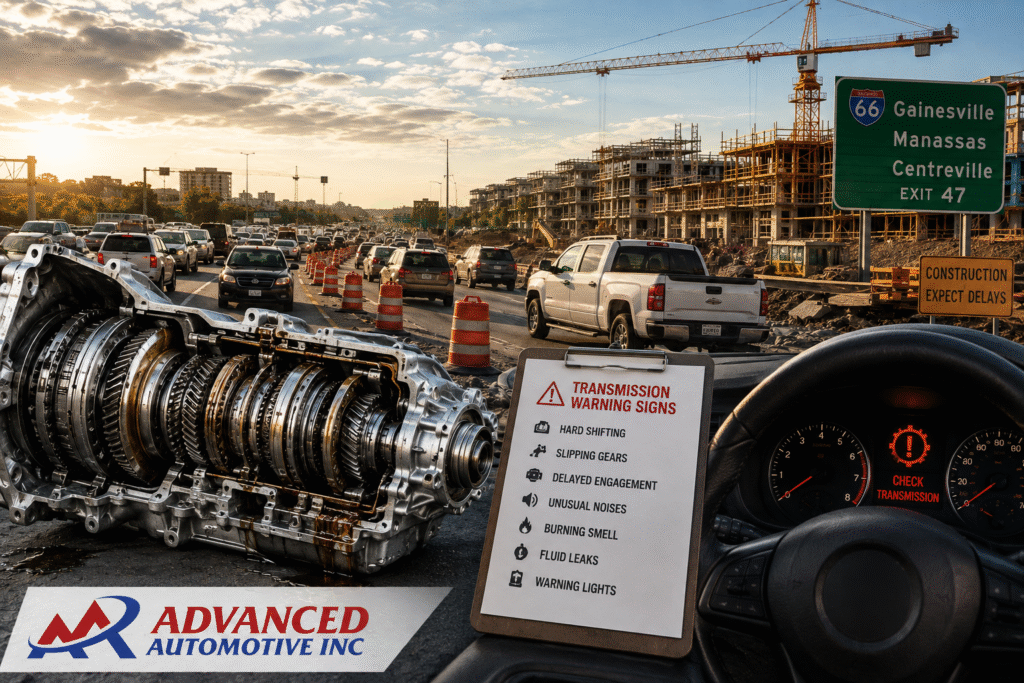
Warning Signs of a Transmission Problem
Transmission problems often provide warning signs before a major failure occurs. Paying attention to those signs can give you an opportunity to diagnose and repair the problem before more expensive damage develops.
Watch for symptoms such as:
- Delayed engagement when shifting into Drive or Reverse
- Hard or harsh shifting
- Hesitation when accelerating
- Slipping between gears
- Engine RPM increasing without a corresponding increase in speed
- Shuddering during acceleration
- Burning smells after heavy traffic
- Transmission fluid leaks
- Check Engine or transmission warning lights
- Unusual noises while shifting
One unusual shift does not necessarily mean your transmission is failing. However, if the same symptom keeps happening, it is worth having the vehicle inspected.
What Does Transmission Slipping Mean?
Transmission slipping is one of the symptoms drivers should take seriously.
You may notice the engine RPM increasing while the vehicle does not accelerate normally. The vehicle may also feel as though it briefly loses power before engaging again.
Slipping can generate additional heat inside the transmission. Continuing to drive while the transmission is slipping may allow a relatively manageable problem to become more serious.
The exact cause can vary. Low or deteriorated fluid, electrical problems, worn internal components, solenoid issues, sensor problems, or other mechanical concerns may produce similar symptoms.
That is why diagnosis is important before deciding what repair is necessary.
How Advanced Automotive Diagnoses Transmission Problems
At Advanced Automotive in Gainesville, the goal is to identify the actual cause of the problem before recommending major repairs.
The diagnostic process may include:
- Computer diagnostics
- Transmission fluid inspection
- Road testing
- Cooling system inspection
- Leak inspection
- Shift-quality evaluation
- Electronic control system testing
- Inspection of related engine and drivetrain components
Not every shifting problem requires transmission replacement.
A faulty sensor, low fluid level, electrical issue, cooling problem, software-related issue, or engine performance problem can sometimes create symptoms that feel like a serious transmission failure.
Proper diagnosis helps determine what is actually happening and what repair makes sense.
How Much Does Transmission Repair Cost?
Transmission repair costs can vary considerably.
A relatively minor issue may cost a few hundred dollars, while major internal repairs or transmission replacement can cost several thousand dollars.
The final price depends on factors such as:
- Vehicle make and model
- Transmission type
- Cause of the problem
- Extent of internal damage
- Parts availability
- Mechanical versus electronic failure
- Labor required for the repair
The best way to avoid unnecessary expenses is to have the problem diagnosed before approving major repairs.
A customer who expects to need a complete transmission replacement may sometimes discover that the actual issue is a sensor, fluid problem, cooling-system concern, or another repair that is significantly less expensive.
Transmission Maintenance for Gainesville Drivers
There is no single maintenance interval that applies to every vehicle. Some manufacturers specify transmission fluid service at particular mileage intervals, while others use different maintenance schedules.
Your owner’s manual should be the starting point for understanding your vehicle’s recommended service requirements.
However, driving conditions matter.
Frequent stop-and-go traffic, towing, high temperatures, extended idling, and other demanding conditions can place additional stress on a vehicle.
If your vehicle regularly spends a significant amount of time in Gainesville traffic, discuss its maintenance requirements with a qualified automotive professional.
Regular inspections can also help identify leaks, cooling problems, deteriorated fluids, or other issues before they become major failures.
Don’t Wait for a Complete Transmission Failure
One of the biggest mistakes drivers can make is ignoring small changes in vehicle behavior.
A slight hesitation today may become a major shifting problem later. A small fluid leak can eventually lead to low fluid levels. Occasional slipping can become increasingly frequent as internal wear progresses.
Getting a vehicle checked does not automatically mean you need an expensive transmission repair.
In many cases, an early diagnosis provides more repair options and can help prevent additional damage.
If your vehicle has recently started shifting differently, hesitating in traffic, slipping between gears, or producing an unusual smell, consider having it inspected.
Trust Advanced Automotive for Transmission Service in Gainesville, VA
Gainesville’s continued growth means traffic and construction are likely to remain part of everyday driving for local residents. While you cannot control the traffic, you can control how quickly you respond when your vehicle begins showing warning signs.
Advanced Automotive helps drivers in Gainesville and surrounding Northern Virginia communities diagnose transmission and vehicle performance concerns before assuming the worst.
If your vehicle is shifting differently or you are concerned about transmission wear, bring it to Advanced Automotive at 13380 University Blvd, Gainesville, VA, or call (703) 665-1818.
Advanced Automotive also serves drivers in Warrenton, Haymarket, Bristow, Manassas, and surrounding Northern Virginia communities.
When it comes to transmission problems, early diagnosis can make a significant difference. Don’t wait until a small warning becomes a major repair.
 Oil Change Gainesville
 Auto Brake Repair Gainesville, VA
  Towing Services Gainesville
  Fleet Services Gainesville
  Virginia Safety & Emissions Inspections
  Air Conditioning & Heating
  Wheel Alignment Warrenton
  Vehicle Diagnostic
  Auto Transmission Repair