

 Locations
 Hours
Hours Call Us Now
 Book Appointment


When it comes to vehicle maintenance, many drivers assume tire rotation and wheel alignment are the same service. While both help protect your tires and improve your driving experience, they serve very different purposes. Understanding the difference can help you avoid premature tire wear, improve fuel efficiency, and keep your vehicle safe on the road.
Whether you’re commuting daily or planning a long road trip, knowing when your vehicle needs a tire rotation, a wheel alignment, or both can save you money and extend the life of your tires.
What Is Tire Rotation?
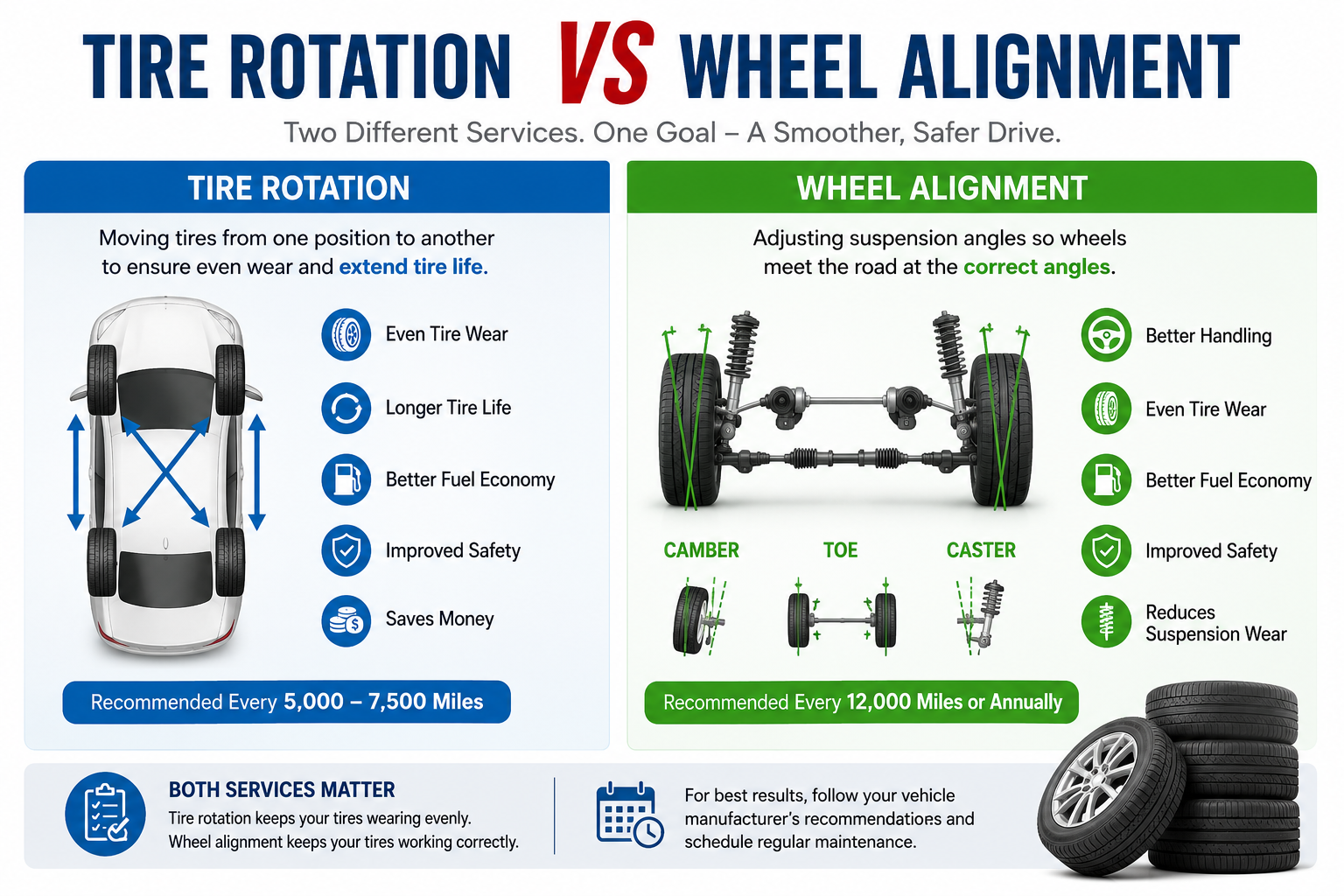
Tire rotation is the process of moving each tire to a different position on your vehicle according to a recommended rotation pattern. Since each tire experiences different levels of wear based on its location, regular rotation helps ensure that all four tires wear evenly.
For example, the front tires on front-wheel-drive vehicles usually wear faster because they handle both steering and power delivery. Rotating the tires distributes this wear more evenly, allowing your tires to last longer.
Benefits of Tire Rotation
- Extends tire life
- Promotes even tread wear
- Improves traction and vehicle stability
- Enhances fuel efficiency
- Reduces road noise and vibrations
- Helps maintain consistent handling
Most manufacturers recommend rotating your tires every 5,000 to 7,500 miles, often during routine oil changes.
What Is Wheel Alignment?
A wheel alignment is a suspension adjustment that ensures your wheels are positioned at the proper angles according to the manufacturer’s specifications. Contrary to popular belief, wheel alignment does not involve adjusting the tires themselves. Instead, technicians adjust the suspension components that determine how the tires contact the road.
Proper wheel alignment improves steering, handling, tire wear, and overall driving safety.
The Three Main Alignment Angles
Camber
Determines whether the tire tilts inward or outward when viewed from the front. Incorrect camber can cause uneven tire wear and poor handling.
Caster
Affects steering stability and cornering performance. Improper caster may result in unstable steering or difficulty maintaining a straight path.
Toe
Measures whether the tires point inward or outward when viewed from above. Incorrect toe settings often lead to rapid tire wear and reduced fuel efficiency.
Tire Rotation vs Wheel Alignment: What’s the Difference?
Although both services protect your tires, they address different issues.
Tire Rotation
- Moves tires to different positions
- Helps tires wear evenly
- Extends tire lifespan
- Recommended every 5,000–7,500 miles
Wheel Alignment
- Adjusts suspension angles
- Improves steering and handling
- Prevents uneven tire wear
- Usually recommended once a year or after suspension repairs
In simple terms, tire rotation manages tire wear, while wheel alignment ensures the tires meet the road correctly.
Signs Your Vehicle Needs a Tire Rotation
If your tires are wearing unevenly, it may be time for a rotation. Common warning signs include:
- Uneven tread depth between tires
- Increased road noise
- Vibrations while driving
- Reduced traction
- You’ve driven more than 5,000 miles since the last rotation
Keeping up with routine tire rotations helps maximize the life of your tires and improves overall driving comfort.
Signs Your Vehicle Needs a Wheel Alignment
Alignment problems often become noticeable while driving. Watch for these symptoms:
- Vehicle pulls to one side
- Steering wheel is off-center
- Uneven tire wear on the inside or outside edges
- Steering feels loose or unstable
- You recently hit a pothole or curb
- Suspension components were recently repaired or replaced
Ignoring alignment issues can significantly shorten tire life and affect vehicle safety.
Why Tire Rotation Matters
Regular tire rotation offers several long-term benefits beyond extending tire life.
Better Tire Performance
Even tread wear provides more consistent traction during rain, snow, and emergency braking situations.
Improved Fuel Economy
Evenly worn tires reduce rolling resistance, allowing your engine to work more efficiently.
Lower Maintenance Costs
Replacing tires prematurely can be expensive. Regular rotations help you get the maximum value from your tire investment.
Smoother Ride
Balanced tire wear often results in fewer vibrations and a quieter driving experience.
Why Proper Wheel Alignment Is Important
Wheel alignment affects much more than steering.
Longer Tire Life
Misaligned wheels can destroy a new set of tires in just a few thousand miles.
Better Handling
Proper alignment improves steering response and helps your vehicle track straight.
Increased Safety
Correct suspension geometry allows your vehicle to respond more predictably during sudden maneuvers.
Reduced Suspension Wear
Maintaining proper alignment helps reduce unnecessary stress on suspension and steering components.
Can You Need Both Services?
Yes. In fact, many vehicles benefit from having both services performed during the same visit.
You may need both if:
- You’re installing new tires
- Uneven tire wear is detected
- Suspension repairs have been completed
- The vehicle has recently struck a pothole or curb
- Steering concerns are present
Combining tire rotation with wheel alignment helps maximize tire performance, safety, and longevity.
How Often Should You Schedule These Services?
General recommendations include:
Tire Rotation
- Every 5,000–7,500 miles
- During regular oil changes
Wheel Alignment
- Once every 12 months
- Every 12,000 miles
- After hitting large potholes or curbs
- Following suspension repairs
- Whenever new tires are installed
Following these intervals helps reduce tire wear and improves your vehicle’s overall performance.
Final Thoughts
Keeping up with regular tire rotations and wheel alignments is one of the easiest ways to improve your vehicle’s safety, handling, fuel efficiency, and tire lifespan. While tire rotation promotes even tread wear, wheel alignment ensures your tires maintain proper contact with the road for a smoother and more controlled driving experience. Scheduling these services at the recommended intervals can help you avoid costly repairs and get the most out of your tires.
If your vehicle is pulling to one side, experiencing uneven tire wear, or it’s simply time for routine maintenance, Advanced Automotive is here to help. Our experienced ASE-certified technicians provide professional tire and alignment services to keep your vehicle performing at its best.
Advanced Automotive
📍 13380 University Blvd, Gainesville, VA 20155
📞 (703) 665-1818
🌐 www.advancedautomotiveva.com
 Oil Change Gainesville
 Auto Brake Repair Gainesville, VA
  Towing Services Gainesville
  Fleet Services Gainesville
  Virginia Safety & Emissions Inspections
  Air Conditioning & Heating
  Wheel Alignment Warrenton
  Vehicle Diagnostic
  Auto Transmission Repair